
Managing multiple websites independently drains time and complicates maintenance for Swiss SMBs. Multi-site hosting enables centralized management and consistent performance across all your sites from one platform. This guide explains what multi-site hosting is, its benefits, key technical aspects, and how to choose the right solution for your business.
Table of Contents
- What Is Multi-Site Hosting?
- Technical Architecture Of Multi-Site Hosting
- Benefits Of Multi-Site Hosting For Swiss SMEs
- Common Misconceptions And Challenges In Multi-Site Hosting
- Multi-Site Hosting Vs Single-Site Hosting: A Comparative Framework
- How To Choose And Implement Multi-Site Hosting For Your Business
- Discover Scalable Multi-Site Hosting With ThunderHosting
- Frequently Asked Questions About Multi-Site Hosting
Key takeaways
| Point | Details |
|---|---|
| Unified management | Multi-site hosting allows centralized control of multiple websites from one platform, streamlining administration. |
| Time savings | Centralized updates reduce maintenance time by about 30% and improve security consistency. |
| Swiss compliance | Local data centers ensure performance, data sovereignty, and compliance with Swiss regulations. |
| Plugin compatibility | Not all plugins or themes work seamlessly in multi-site setups, requiring careful selection and testing. |
| Cost efficiency | Multi-site hosting offers significant resource and cost advantages compared to managing separate single-site hosting plans. |
What is multi-site hosting?
Multi-site hosting supports managing multiple websites or domains under a single hosting platform or installation. This unified approach standardizes administration and data processes, improving efficiency and consistency across all your sites. For example, WordPress multisite hosting allows multiple blogs or sites to run from one WordPress installation.
Multi-site hosting allows management of several websites from a single platform, simplifying administration for businesses with multiple domains. This model shares core infrastructure while maintaining isolated environments for each site. You control security updates, themes, and plugins from one dashboard rather than logging into separate hosting accounts.
Unified multi-site management simplifies security patching, update deployment, and performance monitoring. Instead of repeating the same tasks across five separate hosting accounts, you complete them once. This is particularly valuable for Swiss SMBs managing several websites or domains needing scale and control without multiplying administrative overhead.
Multi-site ERP software standardizes data across locations, enabling unified management and improved operational efficiency. The same principle applies to web hosting: centralized control reduces complexity while maintaining flexibility for individual site customization.
Technical architecture of multi-site hosting
Multi-site hosting relies on sophisticated server configurations that enable efficient resource sharing. Server setups using Apache with PHP-FPM run multiple PHP versions simultaneously, allowing different sites to use different software requirements on the same server. This flexibility is crucial when managing diverse websites with varying technical needs.

The architecture optimizes shared hardware resources to reduce overhead and cost compared to maintaining multiple servers. Each site operates within an isolated environment despite sharing core infrastructure. This isolation protects your sites from each other while maximizing resource efficiency.
Key technical components include:
- Centralized server management enabling consistent security updates and monitoring across all sites
- Optimized virtual hosting architectures that allocate resources dynamically based on demand
- Shared databases with separate tables or prefixes maintaining data separation
- Unified control panels providing streamlined access to all sites
- Load balancing capabilities distributing traffic efficiently across your network
This technical foundation supports diverse site requirements without duplicating infrastructure. You get enterprise-level capabilities at SMB-friendly prices. The domain hosting technology underlying multi-site platforms handles complex routing and resource allocation automatically, so you focus on your business rather than server management.
Benefits of multi-site hosting for Swiss SMEs
Swiss small and medium businesses gain substantial practical advantages from multi-site hosting. Centralized updating reduces maintenance time and security risks across multiple sites, with typical time savings reaching 30% compared to managing sites individually. You deploy updates, security patches, and configuration changes once instead of repeating them across separate hosting accounts.
Local Swiss data centers improve performance and legal compliance for businesses hosting multiple sites. Data sovereignty matters for Swiss businesses, and hosting locally ensures faster load times while meeting Swiss privacy and data protection requirements. You avoid the legal complexity of data transfers outside Switzerland.
Additional advantages include:
- Cost efficiency by sharing resources on one platform instead of paying for duplicated single-hosting plans
- SSD storage and optimized web servers in packages designed for scalability and speed
- Reliable hosting uptime and security with monitoring across your entire network
- Consistent branding and user experience management through shared themes and templates
- Simplified billing with one invoice covering all your websites
Reliable local support tailored to multi-site hosting challenges enhances business continuity. When issues arise, you work with one support team familiar with your entire hosting environment rather than coordinating between multiple providers.
Pro Tip: Evaluate providers’ multi-site management tools and support responsiveness before committing. Request a demo to ensure the interface matches your team’s technical comfort level and that support staff understand multi-site configurations.
Common misconceptions and challenges in multi-site hosting
Multi-site hosting does not eliminate individual site control but does centralize certain administrative functions. Network administrators control plugin and theme installation, which prevents individual site managers from adding unapproved software. This centralization improves security and consistency but requires clear communication about approval processes.
Not all plugins or themes are compatible with multi-site environments. Some popular plugins might not function correctly or require special configuration. Admin permissions and theme editing have specific impacts: editing a shared theme affects all sites using that theme, which benefits uniform branding but risks accidental changes across your network.
Common challenges include:
- Plugin compatibility issues requiring thorough testing before deployment
- Learning curve for administrators unfamiliar with network management interfaces
- Potential single point of failure if the main installation encounters problems
- Limited flexibility for sites requiring highly customized configurations
- Increased complexity in troubleshooting issues affecting multiple sites
Multi-site hosting is not exclusively for large enterprises. Swiss SMEs planning growth benefit significantly from starting with multi-site architecture rather than migrating later. The initial setup requires more planning, but ongoing management becomes simpler as you scale.
Pro Tip: Before deployment, thoroughly test plugins and themes in a staging multi-site environment. Create a test network mirroring your production setup to identify compatibility issues without risking your live sites. Understanding security challenges in multi-site hosting helps you implement proper safeguards from the start.
Multi-site hosting vs single-site hosting: a comparative framework
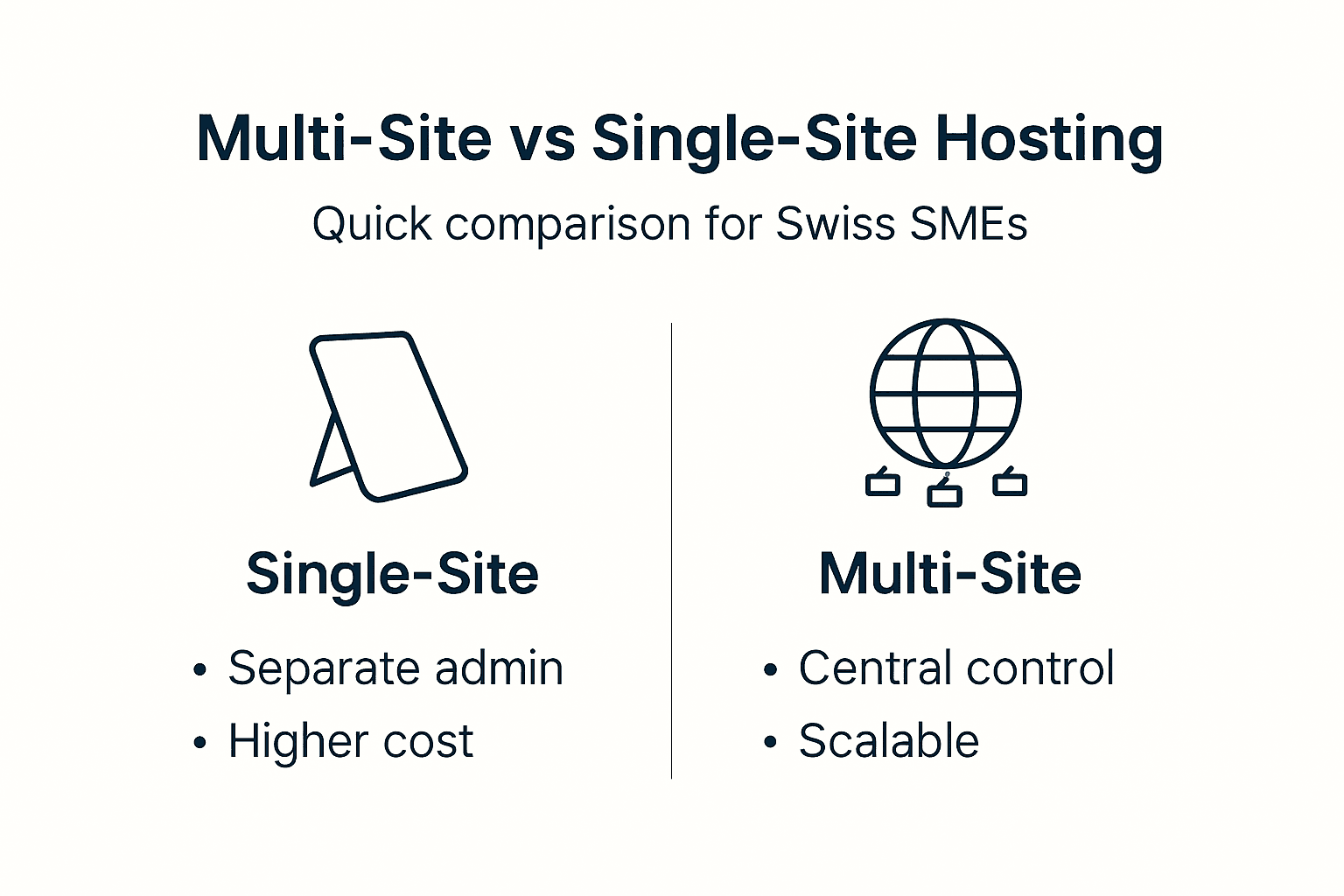
Choosing between multi-site and single-site hosting depends on your current needs and future plans. Single-site hosting involves separate infrastructures per website, offering simpler management but becoming costly and inefficient at scale. Multi-site hosting uses one platform managing multiple websites with centralized control and updates.
Single-site hosting provides straightforward administration familiar to most users. You manage each site independently with full control over plugins, themes, and configurations. However, this independence means repeating security updates, backups, and maintenance tasks for every site. Costs multiply as you add websites.
Multi-site hosting provides cost savings, centralized security, and scalability but requires more administrative expertise initially. You invest time learning network management tools but gain efficiency managing dozens of sites as easily as one. The comparison becomes clearer with specific factors:
| Factor | Single-Site Hosting | Multi-Site Hosting |
|---|---|---|
| Cost | Higher per site; separate plans multiply expenses | Lower overall; shared resources reduce per-site costs |
| Management complexity | Simple per site; multiplied across sites | Steeper learning curve; streamlined at scale |
| Update process | Manual per site; time-intensive | Centralized; one update affects all sites |
| Security consistency | Varies by site; easy to overlook updates | Uniform policies; centralized patching |
| Scalability | Limited; adding sites increases overhead | Excellent; minimal overhead per additional site |
| Customization flexibility | Maximum per site independence | Balanced; some restrictions for network consistency |
| Performance | Isolated; issues contained per site | Shared resources; one problem can affect multiple sites |
For Swiss SMBs managing three or more websites, multi-site hosting typically delivers better value and efficiency. You reduce hosting costs while improving security posture through consistent updates. However, businesses requiring maximum customization per site or managing sites for different clients might prefer separate hosting.
Consider secure hosting options and virtual hosting models when evaluating your specific needs. Your decision should account for current site count, growth projections, technical expertise, and management preferences.
How to choose and implement multi-site hosting for your business
Selecting the right multi-site hosting starts with assessing how many websites you manage and their specific technical requirements. Count your current sites and project growth over the next 12 to 24 months. Document each site’s CMS, traffic levels, storage needs, and critical plugins or themes.
Select providers with local Swiss data centers for compliance, performance, and support advantages. Proximity matters for speed and data sovereignty. Verify the hosting platform offers user-friendly centralized management tools specifically designed for multi-site support, not just multiple single-site accounts under one billing system.
Ensure compatibility with your CMS and important plugins or themes before deployment. Request provider documentation listing known compatibility issues. Test critical functionality in a staging environment provided by the host. Plan for scalable resource allocation aligned with your growth plans, ensuring you can add CPU, RAM, or storage as traffic increases.
Implementation steps:
- Assess your current and projected website needs including traffic, storage, and technical requirements
- Research and compare WordPress hosting for Swiss SMBs providers offering true multi-site capabilities
- Evaluate choosing Swiss hosting providers based on data center locations, support quality, and management tools
- Set up your multi-site environment in staging, configuring network settings and testing core functionality
- Migrate or create individual sites within the network, one at a time to minimize disruption
- Configure centralized security policies, backup schedules, and update procedures for all sites
- Train your team on network administration and site management roles and permissions
- Monitor performance and optimize resource allocation as your network grows
Pro Tip: Train your admin staff on multi-site management tools before going live. Dedicate time for hands-on practice with user management, theme installation, plugin activation, and troubleshooting common issues. This preparation minimizes complexity and avoids common pitfalls during production deployment. Consider scalable Swiss hosting options if you anticipate rapid growth or resource-intensive applications.
Discover scalable multi-site hosting with ThunderHosting
Ready to streamline your website management and reduce maintenance time by 30%? ThunderHosting offers multi-site hosting solutions with local Swiss data centers for reliable performance and compliance. Our packages include centralized management tools ideal for Swiss SMBs managing multiple websites efficiently.
Benefit from SSD storage, expert 24/7 support, and scalable options designed to grow with your business. Our high performance affordable web hosting plans accommodate everything from startup portfolios to enterprise networks. Explore our WordPress hosting optimized for Switzerland to see how multi-site capabilities integrate seamlessly with Swiss business requirements. Learn more about our secure website hosting process to understand how we protect your entire network.
Frequently asked questions about multi-site hosting
What is the main difference between multi-site and single-site hosting?
Multi-site hosting manages multiple websites from one platform, sharing resources and providing centralized control. Single-site hosting involves separate hosting accounts for each site with isolated management. Multi-site offers efficiency and centralized updates; single-site provides simpler but independent administration per website.
Can I use all my favorite plugins on a multi-site network?
Not all plugins are compatible with multi-site environments. Some require network admin approval or might not function as expected in shared installations. Always evaluate plugins beforehand to ensure multi-site support, and test thoroughly in a staging environment before deploying to production sites.
Is multi-site hosting suitable for a small business with only a few websites?
Small businesses managing two to three sites might find single-site hosting simpler initially, especially without technical staff. However, if you plan growth or already manage four or more sites, multi-site hosting delivers immediate time savings and cost efficiency that justify the learning curve.
How does multi-site hosting improve website security?
Centralized updates reduce the risk of outdated software vulnerabilities across all sites in your network. You deploy security patches once rather than remembering to update each site individually. Consistent security policies and unified monitoring help maintain a stronger security posture across your entire web presence.
What should I look for when choosing a multi-site hosting provider?
Prioritize local data centers in Switzerland for compliance and performance advantages. Verify scalable resources and responsive expert support familiar with multi-site hosting configurations. Confirm compatibility with your CMS and needed plugins or themes. Evaluate user-friendly management tools that simplify network administration rather than complicate it.