

Customers outside Switzerland expect your online store to load just as quickly as it does in Zurich. For Swiss e-commerce entrepreneurs, relying on a single hosting location often means lost sales due to slow response times when serving international shoppers. Multi-region hosting keeps your business competitive by placing content closer to global buyers, reducing latency and ensuring a faster, more reliable experience for everyone. Discover how these solutions supercharge performance and safeguard customer satisfaction.
Table of Contents
- Defining Multi-Region Hosting Solutions
- Core Hosting Types and How They Work
- Performance, Latency, and Customer Experience
- Legal Compliance for Swiss Businesses
- Common Risks and Migration Challenges
Key Takeaways
| Point | Details |
|---|---|
| Multi-Region Hosting Enhances Speed | Running your website across multiple regions reduces latency, improving customer experience and conversion rates. |
| Automatic Failover Provides Reliability | In the event of a server outage, traffic is instantly redirected to another operational data center, ensuring continuous service. |
| Compliance with Swiss Regulations is Crucial | Selecting a compliant hosting provider is essential for adhering to Swiss data protection laws and maintaining customer trust. |
| Phased Migration Minimizes Risks | A gradual transition to multi-region hosting reduces the potential for downtime and data inconsistency during the migration process. |
Defining Multi-Region Hosting Solutions
Multi-region hosting means running your online store across multiple data centers in different geographic locations simultaneously. Instead of relying on a single server in one location, your site exists in several places at once.
Think of it like having branches of your business spread across Switzerland, Germany, and beyond. When a customer in Zurich visits your shop, they connect to your nearest server. A customer in Singapore connects to a different one. Everyone gets faster speeds because they’re not traveling thousands of miles to reach your content.
How Multi-Region Hosting Works
Deploying applications across multiple geographic regions improves availability and performance for your customers worldwide. Here’s what happens behind the scenes:
- Identical copies of your website run on servers in different countries
- A smart routing system directs customers to their nearest data center
- If one region fails, traffic automatically switches to another
- Your data stays synchronized across all locations in real time
This approach contrasts sharply with traditional single-location hosting, where all customers connect to one server regardless of where they live.
Why Swiss E-Commerce Businesses Need This
Your customers aren’t just in Switzerland. They’re scattered across Europe, reaching into Asia and North America. A customer ordering from your Geneva-based e-commerce store while sitting in Paris shouldn’t wait for servers in Zurich to respond.
Multi-region hosting reduces latency—that frustrating delay between clicking and loading. Reduced latency means faster checkout experiences, fewer cart abandonments, and higher conversion rates. Studies show that each extra second of loading time costs you sales.
Serving users from their nearest region dramatically improves responsiveness and reliability, directly impacting customer satisfaction and revenue.
Beyond speed, multi-region hosting provides fault tolerance. If your Zurich data center experiences an outage, your German or Finnish locations keep serving customers. Your business never goes dark.

Key Features of Multi-Region Solutions
When evaluating multi-region hosting for your e-commerce operation, look for these core capabilities:
- Automatic failover: Traffic reroutes instantly if a region goes offline
- Load balancing: Requests spread evenly across available servers
- Data replication: Your product catalog, customer data, and orders stay synchronized everywhere
- Global CDN integration: Static files like images and CSS load from nearby servers
- Compliance flexibility: Host data in regions that match your legal requirements
ThunderHosting’s infrastructure spans Germany, Singapore, Finland, and US regions, giving your Swiss business strategic placement for serving both European and international customers effectively.
Pro tip: Start with two or three regions covering your main customer clusters rather than spreading across too many locations, which adds complexity without proportional benefit.
Core Hosting Types and How They Work
When you choose multi-region hosting for your Swiss e-commerce store, you’re selecting from different service models. Each offers distinct advantages depending on your technical expertise and business needs.
Think of these options as a spectrum. On one end, you manage everything yourself. On the other, a hosting provider handles nearly everything. Your job is finding the right balance.
Shared Hosting for Beginners
Shared hosting places your website on a server alongside dozens of other sites. You share processing power, storage, and bandwidth with neighbors. It’s the most affordable option and requires zero technical knowledge.
This works fine for small e-commerce stores with modest traffic. However, if your business grows and traffic spikes, shared hosting can’t keep up. You’ll notice slowdowns during peak hours when neighbors consume resources.
Shared hosting also limits your ability to customize server settings. You’re locked into what the provider allows, which can restrict advanced features your store might need later.
Here’s how core hosting types differ for e-commerce:
| Hosting Type | Resource Control | Customization | Ideal Use Case |
|---|---|---|---|
| Shared Hosting | Minimal, shared access | Limited options | New, low-traffic stores |
| VPS | Dedicated, virtualized | Moderate to high | Growing businesses |
| Dedicated Servers | Full, physical access | Maximum flexibility | High traffic, custom security |
| Managed Cloud | Provider-controlled | High, scalable | Fast growth, less tech hassle |
Virtual Private Servers (VPS)
A VPS carves out a private, isolated section of a physical server just for you. You get dedicated resources—guaranteed CPU, RAM, and storage that neighbors can’t steal.
VPS hosting sits in the middle ground. You have more control than shared hosting but less responsibility than managing a dedicated server. Many Swiss e-commerce businesses start here when they outgrow shared plans.
VPS solutions provide scalable infrastructure that grows with your traffic. You can install custom software, run applications, and configure the environment to your exact specifications.
Dedicated Servers for Maximum Control
With a dedicated server, the entire physical machine belongs to you alone. No other websites compete for resources. This is the most powerful and expensive option.
Dedicated servers deliver predictable, consistent performance. If your e-commerce store handles high transaction volumes or requires specialized security configurations, this is your answer.
The tradeoff? You’re responsible for maintaining, updating, and securing the entire system. Technical expertise is mandatory.
IaaS, PaaS, and Managed Services
Infrastructure as a Service, Platform as a Service, and managed services represent modern cloud approaches. These models integrate virtualized resources, middleware, and application development environments to support your business needs.
- IaaS: You rent computing resources—servers, storage, networking—and manage applications yourself
- PaaS: The provider manages infrastructure; you deploy your code and focus on development
- Managed services: The provider handles nearly everything including updates, backups, and security patches
ThunderHosting offers these modern solutions across its Germany, Singapore, Finland, and US data centers, giving you flexibility and global reach without the complexity.
Managed services eliminate the burden of system administration, allowing you to focus entirely on growing your e-commerce business.
Pro tip: Start by analyzing your current traffic and growth projections, then select the hosting type that provides enough headroom for 18-24 months without over-provisioning and wasting money.
Performance, Latency, and Customer Experience
Speed isn’t a luxury feature for e-commerce—it’s a revenue driver. Every millisecond counts when customers are deciding whether to complete their purchase or abandon their cart.
Multi-region hosting directly addresses this by placing your servers closer to your customers. When a customer in Bern loads your product page, the request travels a shorter distance. Data arrives faster. Pages render quicker. Checkout completes smoother.
The Real Cost of Slow Loading
Slowness kills conversions. Studies consistently show that each additional second of load time increases bounce rates and reduces sales. A customer waiting three seconds is more likely to leave than one experiencing instant results.
This doesn’t just affect impulse purchases. Slow sites damage trust. Customers wonder if your business is legitimate or if their payment data is secure when basic performance lags.
Search engines penalize slow sites too. Google ranks faster websites higher, meaning slowness costs you both customers and visibility simultaneously.
How Latency Impacts Your Bottom Line
Latency is the time between a user action and the server response. Strategically locating data centers close to end users minimizes latency and guarantees efficient service delivery across regions.
Consider your typical customer journey:
- Customer types your URL or clicks an email link
- Browser requests your homepage from the nearest server
- Server responds with HTML, CSS, and JavaScript
- Browser renders the page
- Customer browses products
- Customer adds items to cart
- Customer proceeds to checkout
With multi-region hosting, every step happens faster because data doesn’t travel from Zurich to the customer in Paris, then back again. Everything happens locally.
Performance Metrics That Matter
ThunderHosting’s distributed infrastructure across Germany, Singapore, Finland, and US regions ensures your Swiss business delivers consistent performance globally. Key metrics your customers actually care about include:
- Page load time: Under two seconds for optimal conversion
- Time to first byte: Server response speed, impacted directly by distance
- Bounce rate: Percentage of visitors who leave without interacting
- Conversion rate: Percentage who complete desired action
- Cart abandonment rate: Percentage who leave during checkout
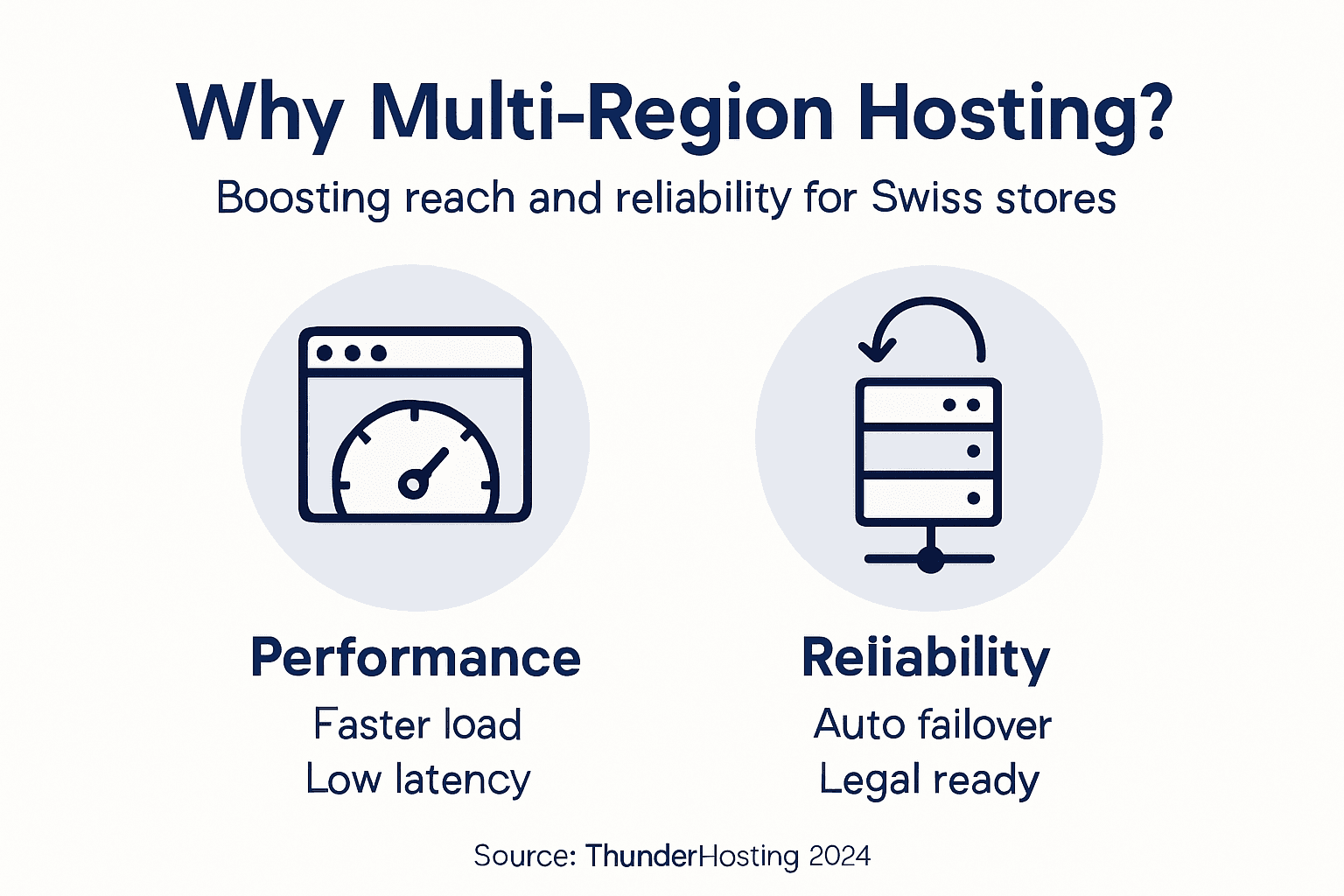
User experience improves dramatically when customers experience response times under 200 milliseconds, directly translating to higher sales and customer loyalty.
Multi-region hosting reduces latency by serving content from the nearest geographic point. Your customer in London connects to your London region. Your customer in Tokyo connects to your Singapore region. Latency drops significantly.
Building Customer Trust Through Reliability
Speed alone isn’t enough. Customers also need reliability. If your site goes down during peak traffic, you lose revenue and reputation.
Multi-region hosting provides automatic failover. If one region experiences an outage, traffic reroutes instantly to another. Your store never goes dark, even during infrastructure problems.
Pro tip: Monitor actual user experience metrics using real visitor data, not synthetic tests, to understand how latency truly impacts your specific customer base and conversion rates.
Legal Compliance for Swiss Businesses
Choosing a hosting provider isn’t just a technical decision for your Swiss e-commerce store—it’s a legal one. Switzerland has some of the world’s strictest data protection regulations, and non-compliance carries serious consequences.
Your hosting choice directly impacts your legal standing. The wrong decision could expose customer data, result in regulatory fines, and damage your reputation irreparably.
Understanding Swiss Data Protection Requirements
Switzerland operates under the Federal Act on Data Protection (FADP)—one of Europe’s most comprehensive privacy frameworks. This law governs how you collect, store, and process customer information.
The FADP requires explicit customer consent before collecting personal data. It mandates strong security measures to protect that data from theft or misuse. It restricts how you share customer information with third parties.
When you choose a hosting provider, you’re entrusting them with customer data. If they violate FADP requirements, you’re liable. Your choice of provider is a compliance choice.
Data Residency and Cross-Border Flows
Swiss data protection laws require businesses to ensure data residency and privacy, with multi-region hosting solutions carefully aligning with Swiss and EU data sovereignty laws. Cross-border data flows require extra scrutiny.
Here’s the practical reality: when you host customer data in Germany, you’re following EU regulations in addition to Swiss rules. When you host in the US, you’re subject to American government data access requests. Your choice of hosting regions matters legally.
ThunderHosting’s infrastructure in Switzerland-adjacent regions like Germany provides a strategic advantage. Your customer data stays within compliant jurisdictions, reducing legal exposure.
Multi-Region Hosting and Compliance
Multi-region hosting creates complexity. Your customer data exists in multiple countries simultaneously. Businesses must architect multi-region hosting environments that enforce data localization when necessary and maintain compliance with national and international regulations.
This means choosing hosting providers carefully:
- Verify their data centers comply with Swiss and EU regulations
- Confirm they sign Data Processing Agreements meeting FADP requirements
- Ensure they provide transparency about where data physically resides
- Check their security certifications (ISO 27001, SOC 2)
- Understand their incident response procedures
Customer Consent and Transparency
Your customers need to know where their data goes. Your privacy policy must disclose hosting locations and data processing practices. If you route customer data through the US, you must notify them.
Transparency isn’t optional—it’s legally mandated. Customers have rights under FADP to access, correct, and delete their data. You must respond to these requests quickly.
Choosing a Swiss-based or EU-compliant hosting provider simplifies legal compliance and demonstrates your commitment to customer data protection.
ThunderHosting’s approach to hosting respects Swiss regulatory requirements, reducing your legal burden and compliance complexity.
Pro tip: Request a Data Processing Agreement from your hosting provider before signing up, and have your legal team review it to confirm FADP and EU regulatory alignment.
Common Risks and Migration Challenges
Moving to multi-region hosting isn’t a simple flip of a switch. Migration presents real risks that can disrupt your business, lose data, or expose customer information if handled carelessly.
Understanding these risks beforehand helps you avoid expensive mistakes. Proper planning and a phased approach minimize disruptions and keep your store running smoothly throughout the transition.
Data Consistency and Synchronization Issues
When your website exists in multiple regions simultaneously, keeping data synchronized becomes critical. A customer places an order in your Paris region. That order must appear instantly in your German region and elsewhere.
Data consistency issues and network outages represent common risks during migration phases. If synchronization fails, inventory counts become inaccurate. Orders duplicate. Customers see different information across regions.
This isn’t just annoying—it costs revenue. An out-of-stock product showing as available causes checkout failures. A customer sees conflicting prices and loses trust.
Downtime and Service Interruptions
Migration requires moving your database, files, and configurations from your current host to new multi-region infrastructure. During this process, your store may go offline.
Even brief downtime during peak shopping hours is devastating. Black Friday sales lost to maintenance. Holiday orders interrupted. Customers go to competitors who remain available.
Careful planning and phased migration are crucial to minimize disruptions. A controlled migration plan with comprehensive risk assessments ensures continuity.
Legacy System Compatibility
Your current setup likely includes custom integrations, old databases, or specialized software. Multi-region hosting requires these legacy systems to work across distributed infrastructure.
Some legacy systems simply aren’t compatible with multi-region architectures. Your ancient inventory management system might not sync across regions. Your payment processor might not support distributed processing.
Identifying these compatibility gaps early prevents painful surprises mid-migration.
Compare migration risks for multi-region hosting:
| Migration Risk | Business Impact | Prevention Strategy |
|---|---|---|
| Data Loss | Lost orders or customer records | Backup all systems beforehand |
| Service Downtime | Lost sales and shopper trust | Migrate in phases, test first |
| Compliance Violation | Legal penalties or fines | Keep data inside compliant zones |
| Legacy Compatibility | Functionality loss or disruption | Assess and update integrations |
Key Migration Risks to Plan For
Approach migration strategically:
- Data loss: Back up everything before migration starts
- Compliance violations: Ensure data stays in compliant regions during transfer
- Performance degradation: Test new infrastructure thoroughly before going live
- Customer experience: Use load balancing to avoid routing errors
- Vendor lock-in: Understand exit strategies before committing
The Phased Approach
Don’t migrate everything at once. Move non-critical systems first. Test thoroughly. Gradually shift traffic to new regions while monitoring performance.
A phased migration lets you catch problems when they’re small. You can rollback if something goes wrong. Your customers barely notice the transition.
A controlled migration plan with comprehensive risk assessment and automation tools ensures success and ongoing reliability in multi-region hosting.
ThunderHosting supports gradual migrations, allowing you to move at your pace without forced downtime or rushing into untested infrastructure.
Pro tip: Run a full dress rehearsal migration on a copy of your production data before executing the actual migration, catching compatibility issues without affecting live customers.
Elevate Your Swiss E-Commerce with Multi-Region Hosting from ThunderHosting
The challenges of delivering fast, reliable service across borders and complying with strict Swiss and international data laws can feel overwhelming. Multi-region hosting eliminates latency issues and downtime risks while ensuring data synchronization and legal compliance. ThunderHosting understands these pain points and offers tailored solutions including VPS, dedicated servers, and managed cloud services hosted in Germany, Singapore, Finland, and US regions. Our infrastructure is optimized to boost your European and global customer experience with low latency and automatic failover.
Accelerate your growth while staying compliant with confidence. We simplify your migration and provide responsive support that keeps your store online and customers happy. Discover how easy it is to harness multi-region advantages with ThunderHosting’s scalable hosting plans.
Ready to transform your e-commerce performance with strategically located servers and professional assistance?
Visit ThunderHosting today and take the first step toward a faster, more reliable, and legally compliant hosting solution built for Swiss businesses.
Explore our offerings now at ThunderHosting and experience hosting designed to power your global reach.
Frequently Asked Questions
What is multi-region hosting?
Multi-region hosting involves running your online store across multiple data centers in different geographic locations. This enables faster access and improved performance for customers, as they connect to the nearest server.
How does multi-region hosting improve website performance?
By deploying your website across various regions, multi-region hosting reduces latency, leading to faster loading times. When users access your site, their requests are routed to the nearest data center, resulting in quicker page renders and smoother checkouts.
What are the key features to look for in multi-region hosting?
Essential features to consider include automatic failover for uninterrupted service, load balancing to distribute traffic evenly, data replication for real-time synchronization, global CDN integration for faster static file loading, and compliance flexibility regarding data regulations.
What are the risks involved in migrating to multi-region hosting?
Migration risks include data synchronization inconsistencies, potential downtime during the transfer process, compatibility issues with legacy systems, and ensuring compliance with data protection regulations. A phased approach to migration can help minimize these risks.
Recommended
- Shopify Hosting Basics: Unlocking Swiss E-Commerce – ThunderHosting
- Domain Hosting Explained: Powering Swiss Business Growth – ThunderHosting
- Virtual Hosting Explained: Boosting Swiss Businesses – ThunderHosting
- Secure Website Hosting Process for Swiss Businesses – ThunderHosting
- The Importance of Reliable Internet