

Growing Swiss SMEs face a critical challenge: outages caused by hosting plans that fail to scale with business demands. Research shows that inadequate hosting infrastructure leads to frequent downtime, lost revenue, and frustrated customers. This guide walks you through a practical process to assess your needs, compare hosting types, evaluate providers based on support quality and data center location, and avoid common mistakes that drain budgets and harm website reliability.
Table of Contents
- Prerequisites And Needs Assessment
- Understanding Hosting Types And Their Tradeoffs
- Evaluating Setup Simplicity And Support Quality
- Importance Of Data Center Location And Latency
- Cost Considerations And Risk Management
- Migration Overview And Timelines
- Common Mistakes To Avoid And Troubleshooting
- Expected Outcomes And Success Metrics
- Explore Reliable Hosting Plans Tailored For Swiss Smes
- Frequently Asked Questions
Key Takeaways
| Point | Details |
|---|---|
| Assess needs first | Evaluate traffic projections and budget before selecting a plan to ensure scalability. |
| Hosting types differ | Shared, VPS, dedicated, and managed hosting vary significantly in cost, performance, and control. |
| Support reduces downtime | Quality 24/7 support correlates with 75% less technical downtime for hosted websites. |
| Location matters | Local data centers reduce latency and meet Swiss data sovereignty requirements. |
| Avoid cheap traps | Lowest-cost plans often lack performance and support, causing costly issues later. |
Prerequisites and Needs Assessment
Before exploring hosting options, define what your website requires now and in the future. Start by estimating current monthly traffic and project growth over the next 12 to 24 months. A site handling 5,000 visitors today may need to accommodate 15,000 within a year as your business expands. Understanding this trajectory helps you choose a plan with room to grow without frequent, disruptive migrations.
Next, inventory your technical resources and budget constraints. Do you have an in-house IT team, or will you rely entirely on provider support? What monthly hosting budget aligns with your revenue projections? These factors directly influence whether you need managed services or can handle server administration yourself.
Swiss data sovereignty laws and latency requirements also play a role. If your customers are primarily in Switzerland or the EU, hosting data locally ensures faster load times and compliance with regional regulations. Finally, list must-have features such as storage capacity, bandwidth limits, email accounts, SSL certificates, and CMS compatibility. This checklist becomes your roadmap when comparing providers.
- Estimate current and projected monthly website traffic
- Identify available technical expertise and budget range
- Determine data location requirements for compliance and speed
- List essential features like storage, bandwidth, and CMS support
Understanding Hosting Types and Their Tradeoffs
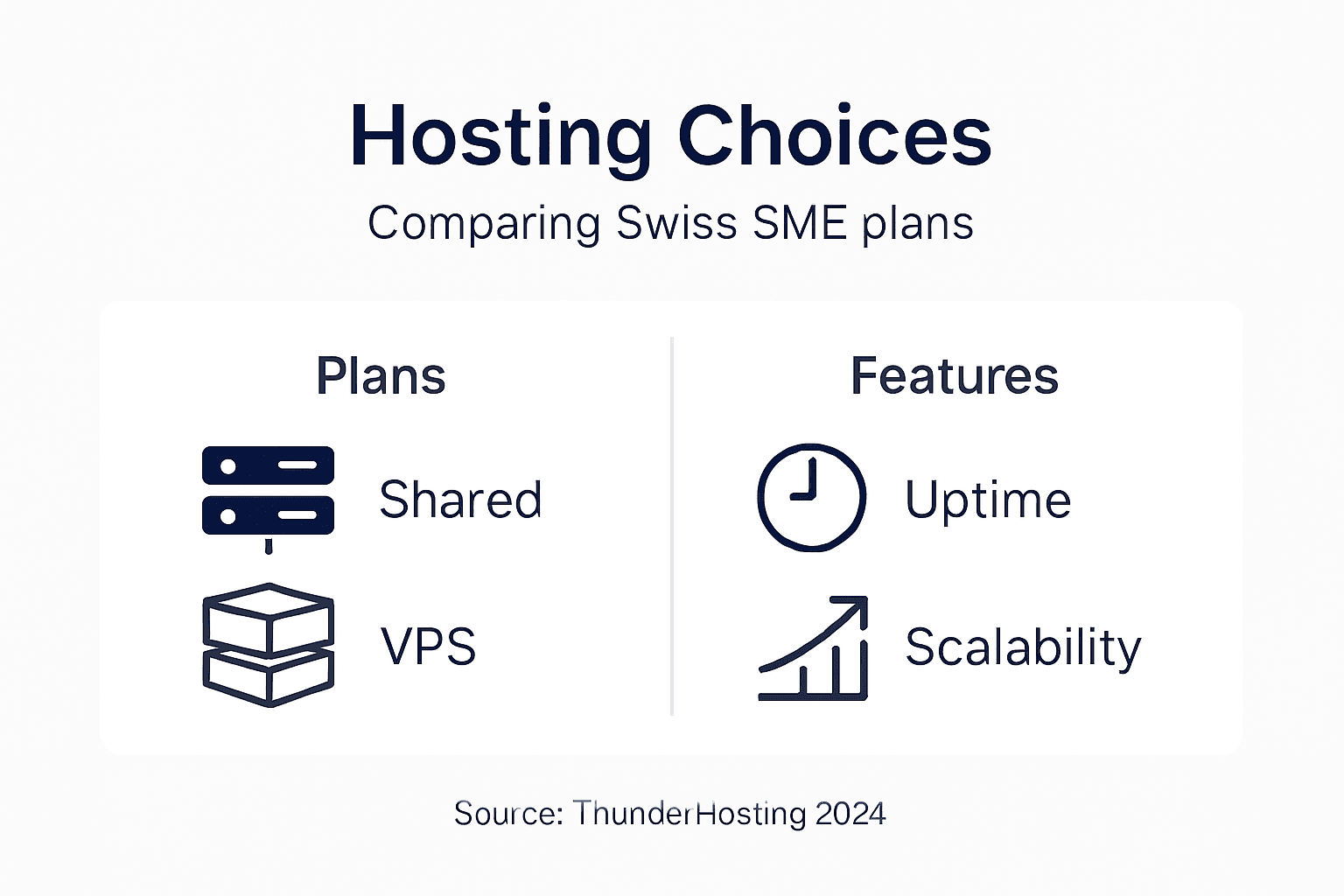
Swiss SMEs can choose from four primary hosting types, each with distinct advantages and limitations. Shared hosting places multiple websites on a single server, offering the lowest cost but limited resources and performance. VPS hosting partitions a server into virtual environments, delivering better control and scalability at moderate prices. Dedicated hosting provides an entire physical server for one client, maximizing performance and customization but at the highest cost. Managed hosting adds expert administration to any of these types, reducing your workload while increasing monthly fees.
The table below compares these options across key criteria relevant to Swiss businesses:
| Hosting Type | Monthly Cost (CHF) | Performance | Scalability | Best For |
|---|---|---|---|---|
| Shared | 5-30 | Low | Limited | Startups, blogs, low traffic sites |
| VPS | 30-150 | Medium-High | Moderate-High | Growing SMEs, moderate traffic |
| Dedicated | 150-500+ | Very High | High | High-traffic sites, custom applications |
| Managed | +20-100 | Varies | Varies | Businesses lacking IT resources |
For most Swiss SMEs, VPS hosting strikes the best balance. It offers custom hosting solutions for Swiss SMBs that scale with demand without the premium cost of dedicated servers. As traffic grows, you can allocate more CPU and RAM within your VPS environment. This flexibility supports business expansion while keeping budgets predictable.
Understanding how servers identify your website also matters. Each site receives a unique IP address that routes traffic correctly. Shared hosting often assigns multiple sites to one IP, while VPS and dedicated plans provide dedicated IPs for better email deliverability and SSL certificate support. When evaluating high performance affordable web hosting, ask providers how IP allocation works and whether upgrades are seamless.
- Shared hosting suits startups with minimal traffic and tight budgets
- VPS delivers scalability and control for growing businesses
- Dedicated servers handle high-traffic sites and custom requirements
- Managed options reduce technical burden across all hosting types
Evaluating Setup Simplicity and Support Quality
Even the best hosting plan fails if setup is complex or support is unresponsive. Look for providers offering guided setup processes that walk you through DNS configuration, CMS installation, and security settings. Many Swiss SMEs lack dedicated IT staff, so streamlined onboarding reduces deployment time from weeks to days.
Support quality directly impacts website uptime and operational efficiency. Comprehensive customer support, including 24/7 live chat and consultative services, correlates with a 75% reduction in technical downtime for hosted websites. This statistic highlights why paying slightly more for robust support often saves money by preventing revenue loss from outages.
Key support features to verify include around-the-clock availability via multiple channels like chat, phone, and email. Consultative help means specialists assist with migrations, performance optimization, and security patches rather than just answering basic questions. Managed security services monitor threats and apply updates automatically, reducing your team’s workload and vulnerability exposure.
Pro Tip: Before committing to a provider, test their support responsiveness by submitting a pre-sales question. Measure how quickly they reply and whether answers demonstrate technical expertise. This simple check reveals whether you’ll receive the help you need when issues arise.
For those considering dedicated infrastructure, our dedicated server setup guide explains how professional support transforms complex deployments into smooth launches. Providers handling server configuration, security hardening, and monitoring free you to focus on business growth rather than technical troubleshooting.
- Guided setup reduces deployment time and eliminates technical barriers
- 24/7 live chat and consultative support prevent costly downtime
- Managed security services protect against threats automatically
- Test support responsiveness before purchase to verify quality
Importance of Data Center Location and Latency
Where your website’s data physically resides affects speed, compliance, and user satisfaction. Hosting data in servers geographically close to your primary audience reduces latency, the delay between a user’s request and your server’s response. For Swiss businesses serving local customers, choosing providers with data centers in Switzerland or nearby EU countries delivers measurably faster load times.

Data sovereignty laws increasingly require certain business information to remain within national or regional borders. Switzerland’s data protection regulations favor hosting sensitive data domestically or within the EU to maintain compliance and avoid legal complications. Providers with Swiss data centers simplify adherence to these requirements while offering lower latency benefits.
Performance benchmarks show that Swiss web hosting latency trends favor local data centers, with average load times 30 to 50 milliseconds faster compared to hosting in distant regions. This difference may seem small, but studies link even minor latency increases to higher bounce rates and lower conversion rates.
If your business targets customers beyond Switzerland, consider multi-region hosting benefits in Switzerland that distribute content across multiple data centers. This approach serves international visitors quickly while maintaining a Swiss data presence for local compliance and performance.
- Proximity to users reduces latency and improves load times
- Swiss and EU data centers ensure compliance with data sovereignty laws
- Local hosting delivers 30-50ms faster response times on average
- Multi-region hosting serves global audiences without sacrificing local performance
Cost Considerations and Risk Management
Swiss SME hosting costs vary widely based on plan type and provider. Shared hosting starts around CHF 5 to 30 monthly, VPS plans range from CHF 30 to 150, and dedicated servers begin at CHF 150 and can exceed CHF 500 for high-performance configurations. Managed services add CHF 20 to 100 per month depending on the level of administration included.
The cheapest plan rarely delivers the best value. Providers offering extremely low prices often oversell server resources, leading to slow load times, frequent outages, and poor support responsiveness. Hidden costs also accumulate quickly when you need to upgrade storage, add bandwidth, or purchase SSL certificates separately. Evaluate total cost of ownership over 12 months rather than just the introductory monthly rate.
Free trials and money-back guarantees mitigate selection risk by letting you test performance and support before committing long-term. Many reputable providers offer 30-day refund periods, giving you time to migrate your site, stress-test resources, and evaluate uptime. Take advantage of these offers to validate that a plan meets your needs in real-world conditions.
Pro Tip: Budget for incremental growth by choosing a plan with easily accessible upgrades. Confirm that your provider allows seamless resource increases without downtime or complex migrations. This approach prevents budget surprises when traffic spikes and ensures your hosting scales smoothly alongside business expansion.
- Shared hosting: CHF 5-30/month, VPS: CHF 30-150/month, Dedicated: CHF 150-500+/month
- Cheapest plans often hide costs and compromise performance
- Free trials and money-back guarantees reduce selection risk
- Plan for growth by confirming easy, downtime-free upgrades
Migration Overview and Timelines
Migrating your website to a new hosting plan involves several steps, each with specific timelines. First, back up all website files, databases, and email accounts. This step takes one to three hours depending on site size. Next, configure your new hosting environment by setting up domains, databases, and email services, which typically requires two to four hours. Transfer files and databases to the new server, a process ranging from 30 minutes to several hours based on data volume.
After transferring data, test the new environment thoroughly before updating DNS records. Verify that pages load correctly, forms submit properly, and all integrations function as expected. This testing phase should take four to eight hours spread over one to two days. Once satisfied, update your domain’s DNS settings to point to the new server. DNS propagation takes 24 to 48 hours, during which some visitors may reach the old server while others see the new one.
Professional migration support from your hosting provider dramatically reduces risk and downtime. Providers offering managed migration services handle technical complexities, reducing data loss and downtime by approximately 60% compared to DIY migrations. They also monitor the process, troubleshoot issues immediately, and ensure minimal disruption to your business operations.
Our website migration step-by-step guide provides detailed checklists and timelines to help you plan effectively. Key checkpoints include verifying backup integrity before transfer, testing thoroughly before DNS changes, and monitoring analytics for traffic anomalies during propagation.
- Back up all website files, databases, and email accounts (1-3 hours)
- Configure new hosting environment with domains and databases (2-4 hours)
- Transfer data to the new server (30 minutes to several hours)
- Test website functionality comprehensively (4-8 hours over 1-2 days)
- Update DNS records and monitor propagation (24-48 hours)
- Verify analytics and functionality post-migration (ongoing for 1 week)
Common Mistakes to Avoid and Troubleshooting
Underestimating bandwidth and storage needs ranks among the most frequent hosting selection errors. A website that initially uses 10 GB of storage may quickly expand to 50 GB as you add product images, blog content, and customer data. Exceeding plan limits triggers automatic upgrades at premium prices or, worse, service suspension during peak traffic periods.
Choosing the lowest-cost plan without evaluating performance metrics leads to poor user experiences and lost revenue. Budget hosting often oversells server capacity, meaning your site competes with hundreds of others for limited CPU and memory. This results in slow load times, especially during traffic spikes, and frequent downtime when servers become overloaded.
Skipping professional migration support increases downtime risk and the likelihood of data loss. DIY migrations without technical expertise often result in misconfigured databases, broken links, and lost email. Studies on common mistakes in hosting and brand registration show that professional assistance reduces migration-related issues by over half.
Learn from dedicated server setup mistakes by planning thoroughly before implementation. Document your current configuration, test backups before migration, and schedule changes during low-traffic periods. These practices minimize disruption and ensure business continuity throughout transitions.
Pro Tip: Implement regular monitoring of bandwidth, storage, and traffic trends. Set alerts when usage reaches 70% of plan limits, giving you time to upgrade proactively rather than reacting to service interruptions. This approach maintains performance while controlling costs.
- Underestimating resource needs causes expensive mid-contract upgrades
- Choosing cheapest plans compromises performance and uptime
- DIY migrations without expertise risk data loss and extended downtime
- Monitor usage proactively and upgrade before hitting limits
Expected Outcomes and Success Metrics
Measuring hosting plan success requires tracking concrete metrics that reflect reliability, performance, and cost efficiency. Uptime percentage is the primary indicator, with 99.9% uptime targets ensuring your site remains accessible to customers. This translates to less than nine hours of downtime annually, a benchmark that reputable Swiss hosting providers consistently meet.
Latency thresholds for Swiss users should stay below 50 milliseconds for optimal satisfaction. Response times exceeding 100 milliseconds noticeably slow page loads, increasing bounce rates and harming search engine rankings. Regular latency testing from Swiss locations verifies that your hosting delivers the speed your audience expects.
Improved support and scalable plans deliver measurable benefits beyond uptime. Businesses report 75% fewer technical incidents requiring urgent intervention when using providers with comprehensive support services. Scalable infrastructure prevents performance degradation during traffic surges, maintaining conversion rates even when visitor counts double or triple unexpectedly.
The table below outlines realistic success metrics for Swiss SME hosting:
| Metric | Target | Measurement Method |
|---|---|---|
| Uptime | 99.9% or higher | Monthly provider reports |
| Latency (Swiss users) | Below 50ms | Speed testing tools |
| Support response time | Under 5 minutes | Average ticket/chat times |
| Page load time | Under 2 seconds | Google PageSpeed Insights |
| Monthly cost variance | Within 10% of budget | Financial tracking |
Balancing cost with performance means accepting that premium hosting delivers better outcomes. A plan costing CHF 80 monthly with 99.95% uptime saves more money than a CHF 20 plan with 98% uptime when you account for lost revenue during outages. Track deployment timelines and budget variances quarterly to ensure your hosting investment aligns with business growth and profitability targets.
Explore Reliable Hosting Plans Tailored for Swiss SMEs
Choosing the right hosting plan transforms website reliability and business growth potential. ThunderHosting specializes in scalable, high-performance solutions designed specifically for Swiss SMEs navigating the challenges of online expansion. Our infrastructure combines local data centers for optimal latency with 24/7 expert support that reduces downtime by three-quarters compared to industry averages.
Whether you need affordable web hosting plans for a growing online presence, VPS hosting options that scale with your traffic, or dedicated server hosting for high-performance applications, our team guides you through setup and migration at no additional cost. Explore our range of hosting solutions tailored to Swiss business requirements and discover how the right infrastructure supports your success.
Frequently Asked Questions
What is the best hosting type for growing small businesses in Switzerland?
VPS hosting typically suits growing Swiss SMEs best because it balances cost, performance, and scalability. Shared hosting becomes limiting as traffic increases, while dedicated servers exceed most small business budgets and technical needs. VPS plans allow resource upgrades without migration, supporting steady growth.
How important is local data center location for my website speed?
Data center proximity significantly impacts load times, with Swiss-hosted sites delivering 30 to 50 milliseconds faster responses to local visitors compared to distant servers. This speed difference affects bounce rates, conversion rates, and search rankings. Local hosting also simplifies compliance with Swiss data sovereignty requirements.
Can I upgrade my hosting plan easily as my business grows?
Reputable providers allow seamless upgrades without downtime or complex migrations, especially with VPS and cloud hosting. Before selecting a plan, confirm that your provider supports one-click resource scaling or offers migration assistance for plan changes. This flexibility prevents business disruption when traffic increases.
What should I look for in hosting support services?
Prioritize 24/7 availability through multiple channels like live chat, phone, and email. Support teams should offer consultative help beyond basic troubleshooting, assisting with migrations, security, and performance optimization. Test responsiveness before purchase and verify that support staff demonstrate technical expertise rather than reading scripts.
How long does migration usually take and can I avoid downtime?
Typical migrations require one to three days including backup, transfer, testing, and DNS propagation. Professional migration services reduce this timeline and minimize downtime to near zero by coordinating DNS changes carefully. DIY migrations often extend to a week or more and risk data loss without technical expertise, making provider support worthwhile.
Recommended
- Swiss E-Commerce Hosting: 99.9% Uptime Reduces Bounce 40% – ThunderHosting
- VPS vs Dedicated Servers Switzerland 2026: Save 40-70% – ThunderHosting
- Web Hosting Trends 2026: 50% Latency Cuts for Swiss Sites – ThunderHosting
- Domain Hosting Explained: Powering Swiss Business Growth – ThunderHosting
- Start-ups – Brndpwr
- Start-ups – Brndpwr