

Many Swiss SMB owners believe VPS hosting always underperforms compared to dedicated servers. Recent benchmarks show modern VPS can reach 85 to 95% of dedicated server CPU performance when optimized. Choosing the right hosting involves balancing cost, performance, scalability, and control. This guide clarifies the real differences between VPS and dedicated servers, explores trade-offs, and provides practical decision tools for 2026 to help you select the best hosting for your business needs.
Table of Contents
- Understanding VPS And Dedicated Servers: Architecture And Core Differences
- Performance And Reliability: Impact Of Resource Sharing
- Cost Comparison: Quantifying Expenses In The Swiss Market
- Security And Control: Dedicated Vs Shared Environments
- Common Misconceptions About VPS And Dedicated Servers
- Use Cases And Decision Framework For Swiss SMBs
- Practical Considerations For Migration And Growth
- Explore Optimized VPS And Dedicated Hosting Solutions At ThunderHosting
- Frequently Asked Questions
Key Takeaways
| Point | Details |
|---|---|
| VPS offers virtualized hosting | Shared hardware with scalable resources at 40 to 70% lower cost than dedicated servers. |
| Dedicated servers provide exclusive access | Full hardware control delivers higher performance consistency and enhanced security. |
| Modern VPS performance improves | Optimized configurations reach up to 95% of dedicated server CPU performance. |
| Uptime differences matter | Dedicated servers guarantee 99.99% uptime versus 99.9% for VPS. |
| Migration and scaling differ | VPS scales quickly via virtualization while dedicated servers require slower hardware provisioning. |
Understanding VPS and Dedicated Servers: Architecture and Core Differences
VPS stands for Virtual Private Server. It creates virtual partitions on shared physical servers using virtualization technology. Each partition operates independently with its own operating system and allocated resources. Dedicated servers provide exclusive access to an entire physical machine without sharing hardware with anyone else.
Resource allocation differs fundamentally between these options. VPS shares underlying hardware like CPU, RAM, and storage across multiple virtual environments. What is VPS hosting explains how hypervisors manage this resource distribution efficiently. Dedicated servers grant full access to all hardware resources without dividing or sharing them.
Virtualization enables VPS to scale resources dynamically and maintain isolation between tenants. You can upgrade RAM or CPU cores within minutes without physical hardware changes. However, shared resources mean performance can fluctuate when neighboring virtual environments consume heavy resources.
Key architectural distinctions include:
- Control level: Dedicated servers offer complete hardware control including BIOS access and custom network configurations
- Customization: VPS limits hardware modifications but allows extensive software customization within virtual boundaries
- Isolation: Dedicated servers provide physical isolation while VPS relies on software-based separation
- Flexibility: VPS supports rapid resource adjustments versus dedicated servers requiring hardware swaps
These architectural differences create cascading effects on performance, cost, security, and operational complexity. Understanding these foundations helps you evaluate which hosting type aligns with your specific business requirements and technical capabilities.
Performance and Reliability: Impact of Resource Sharing
Resource sharing fundamentally shapes VPS performance characteristics. The noisy neighbor effect occurs when one virtual environment consumes excessive resources, reducing available capacity for others on the same physical server. This causes performance dips during peak usage periods that dedicated servers avoid entirely.
Uptime guarantees reflect these architectural realities. Dedicated servers have higher uptime guarantees (99.99%) versus VPS (99.9%) due to exclusive resource access and fewer potential failure points. The 0.09% difference translates to approximately 8 additional hours of potential downtime per year for VPS.

Benchmark data reveals modern VPS can reach 85 to 95% CPU performance compared to dedicated servers when properly configured. Memory and storage performance gaps narrow even further with NVMe drives and optimized virtualization layers. For many Swiss SMBs, this performance level suffices for standard business applications.
Performance consistency matters more than peak performance for mission-critical applications. Dedicated servers deliver predictable response times because no external factors compete for resources. Your database queries execute in stable timeframes. Your application handles traffic spikes without unexpected slowdowns from neighboring tenants.
Reliability impacts business continuity and customer trust directly. Downtime costs Swiss SMBs an average of CHF 5,000 to CHF 15,000 per hour depending on business type and size. Benefits of dedicated hosting include eliminating shared resource risks that could trigger service interruptions during critical business periods.
Pro Tip: Monitor your VPS performance metrics for 30 days before committing long term. Track CPU steal time, which indicates when the hypervisor allocates your CPU cycles to other virtual environments. Consistent steal time above 5% signals resource contention issues requiring provider discussion or dedicated server migration.
Cost Comparison: Quantifying Expenses in the Swiss Market
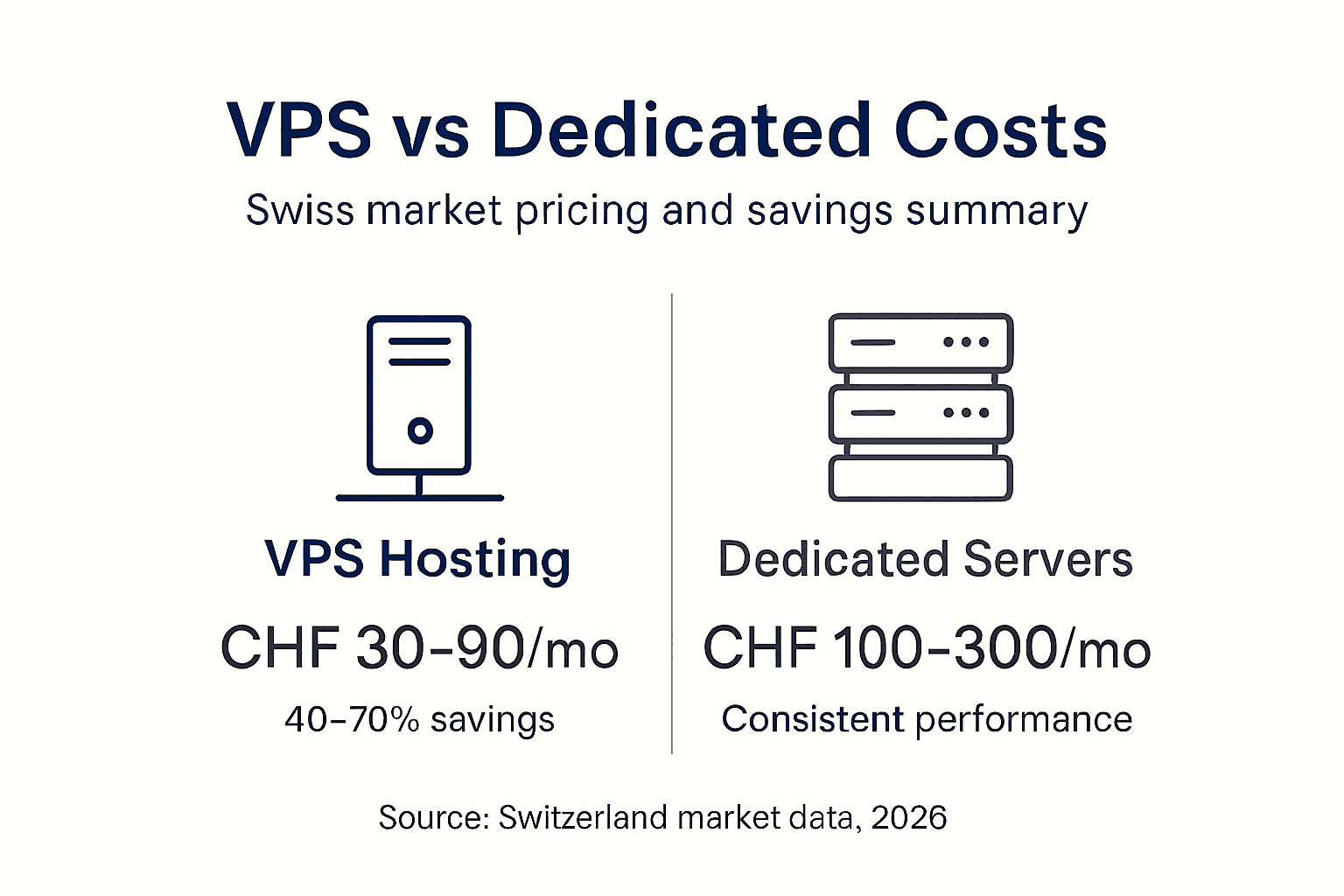
VPS hosting costs in Switzerland range from CHF 30 to 90 per month, while dedicated servers cost CHF 100 to 300 per month. This pricing structure makes VPS 40 to 70% more affordable for budget-conscious SMBs. The table below shows typical Swiss market pricing for comparable configurations.
| Configuration | VPS Monthly Cost | Dedicated Monthly Cost | Savings with VPS |
|---|---|---|---|
| Entry Level | CHF 30 to 50 | CHF 100 to 150 | 50 to 70% |
| Mid Range | CHF 50 to 90 | CHF 150 to 250 | 40 to 60% |
| High Performance | CHF 90+ | CHF 250 to 300+ | 30 to 40% |
Total cost of ownership extends beyond base monthly fees. Factor in upgrade costs, technical support packages, backup services, and bandwidth overages. VPS typically bundles more services in base pricing while dedicated servers often charge separately for managed services, security monitoring, and hardware replacements.
VPS delivers cost efficiency for SMBs with moderate traffic and standard application requirements. Your monthly hosting budget stays predictable while scaling resources incrementally as business grows. VPS hosting plans at ThunderHosting include automated backups and security monitoring without additional charges.
Dedicated servers justify higher prices when performance consistency and security requirements outweigh cost concerns. Financial services, healthcare providers, and e-commerce platforms handling sensitive customer data often require dedicated infrastructure regardless of price premiums. Dedicated server options provide the isolation and control these industries demand.
Pro Tip: Negotiate bundled support and upgrade packages when signing multi-year contracts. Many Swiss hosting providers offer 15 to 25% discounts on total costs when you commit to 24 or 36 month terms. Request written guarantees for upgrade paths and migration assistance to protect your investment as business needs evolve.
Security and Control: Dedicated vs Shared Environments
Multi-tenant VPS environments introduce security considerations because multiple virtual environments share physical hardware. Vulnerabilities in hypervisor software or misconfigurations could theoretically expose data across tenant boundaries. Modern virtualization platforms mitigate these risks through robust isolation mechanisms, but shared infrastructure inherently presents more attack surface than dedicated hardware.
Dedicated servers provide enhanced security through complete physical isolation. No other organizations access your hardware, eliminating cross-tenant attack vectors entirely. You control firmware updates, security patches, and network configurations down to the hardware level. This isolation proves critical for organizations handling sensitive financial records, health data, or proprietary business intelligence.
Root access and customization capabilities differ significantly between hosting types. Dedicated servers grant unrestricted access to modify BIOS settings, install custom kernel modules, and configure specialized networking equipment. VPS environments restrict certain low-level modifications to maintain hypervisor stability and prevent tenant interference.
Swiss data privacy laws including the Federal Act on Data Protection require appropriate technical measures to protect personal information. Secure hosting practices become legally mandated, not optional. Dedicated servers simplify compliance by providing clear data boundaries and eliminating shared infrastructure concerns during audits.
Key security and control factors include:
- Physical access: Dedicated servers prevent other organizations from sharing hardware that processes your data
- Compliance documentation: Dedicated infrastructure simplifies audit trails and regulatory reporting
- Custom security tools: Install specialized intrusion detection systems and hardware security modules
- Network segmentation: Create isolated network zones with dedicated hardware and switches
Pro Tip: Conduct quarterly security audits regardless of hosting type. Review provider SLAs for security incident response times, patch management policies, and backup retention periods. Request documentation of their physical security measures, staff background checks, and access logging procedures to verify adequate protection for your business data.
Common Misconceptions About VPS and Dedicated Servers
The belief that VPS always significantly underperforms dedicated servers persists despite technological advances. Modern VPS can approach 85 to 95% of dedicated server performance when optimally configured. Container-based virtualization and hardware-assisted virtualization technologies have narrowed the performance gap substantially over the past five years.
Migration complexity gets oversimplified in hosting discussions. Moving between VPS instances on the same provider typically completes within hours. Migrating from VPS to dedicated servers or between different providers involves considerable planning, testing, and potential downtime lasting a full business day or longer. Application dependencies, database synchronization, and DNS propagation add layers of complexity.
Many assume VPS and dedicated server scaling require equal effort and time investment. VPS scaling leverages virtualization to add resources within minutes through provider control panels. Dedicated server scaling requires hardware procurement, installation, configuration, and potential physical rack space allocation. This process extends from several days to weeks depending on hardware availability and data center capacity.
The myth that all VPS providers deliver identical performance ignores infrastructure quality differences. Provider selection significantly impacts actual performance regardless of advertised specifications. Network backbone quality, storage technology choices, oversubscription ratios, and hypervisor optimization vary widely across hosting companies.
Common misconceptions to avoid:
- Believing VPS cannot handle production workloads requiring consistent performance
- Assuming dedicated servers always cost prohibitively more without comparing total ownership costs
- Thinking migration between hosting types happens seamlessly without business disruption
- Expecting identical security postures between shared and dedicated environments
Custom hosting solutions address unique requirements that standard VPS or dedicated packages cannot accommodate. Verify provider capabilities through performance testing and reference checks before committing to multi-year contracts based on assumptions rather than validated evidence.
Use Cases and Decision Framework for Swiss SMBs
VPS hosting suits Swiss SMBs with specific operational patterns and constraints. Consider VPS when your traffic fluctuates seasonally, your budget prioritizes cost efficiency, and your applications tolerate occasional performance variations. Development and staging environments benefit from VPS flexibility without requiring dedicated server investment.
Dedicated servers match SMBs requiring consistent peak performance during business-critical periods. Financial services firms processing transactions, medical practices managing electronic health records, and e-commerce sites handling high-value purchases justify dedicated infrastructure costs. Security compliance requirements often mandate dedicated hosting regardless of traffic volume.
Follow this five-step decision framework to evaluate hosting options systematically:
- Assess workload patterns by reviewing traffic analytics, database query volumes, and peak usage times over the past 90 days
- Calculate realistic budget including base hosting fees, support costs, backup services, and projected scaling expenses
- Determine control requirements based on application architecture, custom software dependencies, and technical team capabilities
- Evaluate security and compliance obligations under Swiss data protection laws and industry-specific regulations
- Project growth trajectory considering customer acquisition plans, new product launches, and market expansion goals
Cost-performance trade-offs vary across Swiss SMB profiles. A Zurich-based consulting firm serving 50 to 100 clients operates effectively on mid-range VPS at CHF 60 to 80 monthly. A Geneva financial advisory managing client portfolios requires dedicated servers at CHF 200 to 250 monthly for regulatory compliance and data security.
Operational factors influence hosting decisions beyond technical specifications. Migration support quality determines how smoothly you can adjust hosting as business evolves. Virtual hosting basics explain foundational concepts for SMBs new to infrastructure decisions. Tailored hosting solutions bridge gaps when standard packages do not match your requirements precisely.
Consider hybrid approaches combining VPS for development environments with dedicated servers for production workloads. This strategy optimizes costs while maintaining performance and security where they matter most. Secure hosting process guidance helps implement multi-tier architectures effectively.
Practical Considerations for Migration and Growth
Migration downtime ranges from several hours to a full business day depending on data volume and application complexity. Simple websites with small databases migrate faster than complex applications with multiple integrated services. Plan for extended timelines when moving between fundamentally different hosting architectures like VPS to dedicated servers.
Technical challenges extend beyond simple file transfers. Database synchronization requires careful timing to prevent data loss during cutover. Application configurations often need adjustments for new server environments. DNS propagation introduces 24 to 48 hour periods where some users reach old servers while others connect to new infrastructure.
Best practices for planning growth without service disruption:
- Test migration procedures on staging environments before touching production systems
- Schedule migrations during historically low traffic periods based on analytics data
- Maintain parallel environments during transition periods to enable quick rollback if issues emerge
- Communicate timeline expectations to customers and stakeholders proactively
- Document all configuration changes and dependencies for future reference
Choosing providers with robust migration support minimizes business risk during transitions. ThunderHosting offers free migration assistance for new customers moving from other hosting providers. Technical teams handle data transfers, application configuration, and DNS updates while you focus on business operations.
Dedicated server setup guide walks through configuration steps for optimal performance and security. Following structured approaches reduces errors and shortens deployment timelines significantly.
Pro Tip: Schedule migrations during off-peak hours like weekend nights or early Monday mornings when traffic typically drops 60 to 80% below peak levels. Monitor application performance continuously for 72 hours post-migration to catch configuration issues before they impact customer experience significantly. Keep previous hosting environment accessible for one week after migration to enable rapid data recovery if unexpected problems surface.
Explore Optimized VPS and Dedicated Hosting Solutions at ThunderHosting
ThunderHosting delivers affordable VPS plans combining cost efficiency with scalability for growing Swiss SMBs. Our virtualized infrastructure provides reliable performance without the premium pricing of dedicated hardware. High performance dedicated servers offer exclusive hardware access when your business demands maximum reliability and control.

We understand Swiss SMBs face unique hosting challenges balancing budget constraints with performance requirements. Our custom hosting solutions adapt to your specific business needs whether you require VPS flexibility or dedicated server power. Data centers in Germany and Finland ensure low latency for European customers while maintaining Swiss data privacy standards. Explore our hosting options to find solutions matching your technical requirements and business growth trajectory.
Frequently Asked Questions
What performance difference should Swiss SMBs expect between VPS and dedicated servers?
Modern VPS reaches 85 to 95% of dedicated server CPU performance when properly configured. Memory and storage performance gaps narrow further with NVMe technology. Dedicated servers provide more consistent performance during peak loads without noisy neighbor effects.
How much can Swiss SMBs save by choosing VPS over dedicated servers?
VPS costs 40 to 70% less than dedicated servers in Switzerland. Entry level VPS starts at CHF 30 to 50 monthly versus CHF 100 to 150 for comparable dedicated servers. Total savings depend on configuration requirements and included services.
When should a Swiss SMB choose dedicated servers instead of VPS?
Select dedicated servers when you need guaranteed performance consistency, enhanced security through physical isolation, or compliance with strict data protection regulations. Financial services, healthcare, and high-value e-commerce typically require dedicated infrastructure regardless of cost premiums.
How long does migrating from VPS to dedicated servers typically take?
Migration timelines range from several hours for simple sites to a full business day for complex applications. Database synchronization, application reconfiguration, and DNS propagation add time. Plan for 24 to 48 hour transition periods including testing and validation.
Can VPS hosting meet Swiss data privacy compliance requirements?
Reputable VPS providers implement strong isolation and encryption meeting Federal Act on Data Protection requirements. However, dedicated servers simplify compliance documentation and audit trails by eliminating shared infrastructure concerns. Consult legal counsel for industry-specific regulations.
What security advantages do dedicated servers provide over VPS?
Dedicated servers eliminate cross-tenant attack vectors through complete physical isolation. You control all firmware updates, security patches, and network configurations without hypervisor dependencies. This proves critical for organizations handling sensitive financial or health data under Swiss privacy laws.