

Running a thriving online store in Switzerland means meeting high shopper expectations for speed, security, and reliability. For entrepreneurs managing busy e-commerce platforms, shared hosting often falls short under real-world traffic surges. Dedicated hosting delivers full administrative control and privacy aligned with Switzerland’s stringent Federal Act on Data Protection. Discover how a dedicated server can provide consistent performance, true customization, and peace of mind as your business grows.
Table of Contents
- What Dedicated Hosting Means Today
- Comparing Hosting Types For E-Commerce
- Control, Security, And Customization Advantages
- Key Costs, Risks, And Common Pitfalls
- Is Dedicated Hosting Right For You
Key Takeaways
| Point | Details |
|---|---|
| Dedicated Hosting Advantages | Provides full administrative control, allowing businesses to customize infrastructure for optimal performance and security. |
| Regulatory Compliance | Ensures alignment with Swiss data protection laws, critical for businesses handling sensitive customer information. |
| Performance and Scalability | Ideal for high-traffic e-commerce platforms, mitigating slowdowns that impact customer experience and revenue. |
| Cost and Resource Management | Requires careful budgeting and planning to avoid overspending or resource misallocation as businesses grow. |
What Dedicated Hosting Means Today
Dedicated hosting has evolved from a luxury for large corporations into a practical solution for growing Swiss e-commerce businesses. Unlike shared hosting, where your website shares server resources with hundreds of other sites, dedicated hosting means you have an entire server to yourself. This fundamental difference shapes everything about performance, control, and security.
In today’s context, dedicated hosting provides full administrative control over your server environment. You manage the operating system, install custom software, configure security settings, and optimize the BIOS—something impossible on shared plans. This level of control allows you to build exactly the infrastructure your online store needs.
For Swiss-based e-commerce entrepreneurs, dedicated hosting solutions offer critical advantages aligned with local regulations. Your data stays within Switzerland’s strict privacy framework, complying with the Federal Act on Data Protection (DSG) and GDPR requirements that customers increasingly expect.
Modern dedicated servers come in different forms:
- Managed dedicated servers (ThunderHosting handles updates, security, backups)
- Unmanaged dedicated servers (you control everything; requires technical expertise)
- Bare metal servers (raw hardware access; maximum customization)
- Hybrid configurations (mix of managed and unmanaged services)
The shift toward dedicated hosting reflects real market changes. Swiss merchants processing higher transaction volumes (typically 50,000+ monthly visitors) experience noticeable slowdowns on shared servers. Real customers abandon slow carts—studies show a 1-second delay cuts conversions by approximately 7%. Dedicated hosting eliminates this bottleneck.
Today’s dedicated servers also emphasize flexibility. ThunderHosting’s infrastructure spans global data centers in Germany, Singapore, Finland, and US regions, meaning you can place your server geographically closer to your primary customer base while maintaining Swiss-compliant data governance.
Dedicated hosting gives you one essential thing shared plans cannot: predictable, consistent performance under real business conditions.
Security operates differently on dedicated infrastructure. You’re not vulnerable to “noisy neighbor” attacks where another site’s compromise affects yours. Your firewall rules, SSL certificates, and intrusion detection remain entirely under your control.
Pro tip: If you’re moving from shared hosting, budget time for server configuration—most migrations require 2-4 weeks of planning to ensure your custom setup translates correctly to the new environment.
Comparing Hosting Types for E-Commerce
Choosing the right hosting foundation determines whether your online store thrives or struggles. Different hosting types serve different business stages, and Switzerland’s strict data protection requirements add another layer to consider when evaluating options.
Shared hosting works for small startup stores with minimal traffic. You pay the least, but your site shares server resources with potentially hundreds of others. Performance suffers under load, and customization options are restricted. Swiss compliance features are often generic rather than tailored.
VPS hosting (Virtual Private Server) splits a physical server into isolated virtual machines. You get more control and predictability than shared hosting, with dedicated CPU and RAM allocated to your account. Scaling becomes easier as traffic grows, and you can install custom software. However, you still manage server administration tasks yourself.
When comparing hosting environments for high-traffic e-commerce platforms, dedicated hosting delivers maximum performance without compromise. Your entire server belongs to you—no resource sharing, no speed degradation when neighbors spike traffic.

Key differences between hosting types:
Here’s a concise breakdown of hosting types by business stage, control, and scalability:
| Hosting Type | Best For | Administrative Control | Scalability |
|---|---|---|---|
| Shared | New, small startups | Limited | Minimal |
| VPS | Growing businesses | Moderate | Flexible |
| Dedicated | High-traffic platforms | Full | Manual upgrades |
| Cloud | Expanding enterprises | Variable | Instant on demand |
- Shared: Low cost, limited control, performance varies by other users
- VPS: Mid-range pricing, good customization, requires technical knowledge
- Dedicated: Highest cost, full control, consistent performance
- Cloud: Pay-as-you-go scalability, complexity, potential sovereignty concerns
For Swiss merchants handling sensitive customer data, dedicated hosting offers regulatory advantages. Your infrastructure stays under your control, aligning with Switzerland’s Federal Act on Data Protection requirements and ISO 27001 standards. Data sovereignty concerns disappear when your server is physically dedicated to your business.
Performance metrics differ dramatically. A dedicated server reliably handles 100,000+ monthly visitors without slowdown. Shared hosting typically breaks around 50,000 visitors. VPS sits between them, scaling to roughly 75,000 visitors depending on configuration.
Dedicated hosting eliminates the performance variability that plagues shared and VPS environments during traffic spikes.
Transaction processing also matters for e-commerce. Dedicated infrastructure provides the SSL certificate management, firewall configuration, and intrusion detection that payment processors increasingly require. You control security policies entirely.
Pro tip: Start with VPS if you’re scaling from shared hosting, then migrate to dedicated when monthly traffic approaches 40,000 visitors—this timing prevents sudden performance crashes while managing infrastructure costs.
Control, Security, and Customization Advantages
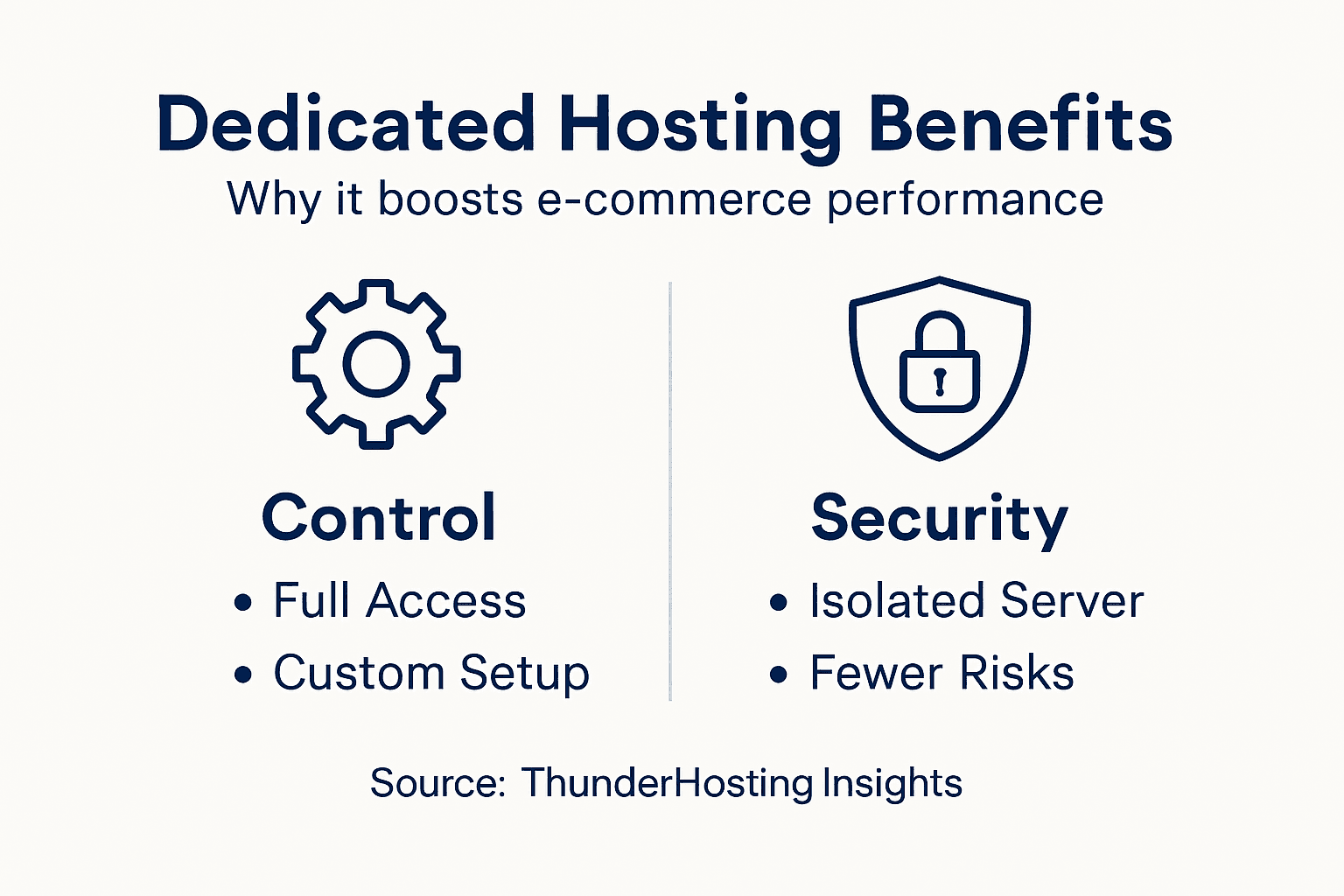
Dedicated hosting grants you something shared and VPS plans cannot: complete administrative control over your entire server environment. You decide which software runs, how resources allocate, and which security rules apply—without waiting for provider approval or worrying about other users’ configurations affecting yours.
This control translates directly to business advantages. Your e-commerce platform can run custom code, integrate specialized payment gateways, or optimize databases specifically for your product catalog. You configure server settings at every level, from operating system parameters to application-level customization.
Security operates at a fundamentally different level on dedicated infrastructure. Dedicated servers include firewalls, DDoS protection, and hardware encryption that you control directly. No shared vulnerabilities. No dependency on another tenant’s security practices. Your SSL certificates, firewall rules, and intrusion detection belong entirely to your business.
Swiss dedicated servers add regulatory protections:
- Encryption at hardware and application levels
- Compliance with strict data protection laws automatically
- Data sovereignty keeps customer information within Switzerland’s borders
- Audit readiness simplifies regulatory compliance documentation
- Access control defines exactly who can reach your infrastructure
Customization extends to performance optimization. You install caching solutions like Memcached, configure your exact PHP or Node.js version, or run specialized databases optimized for e-commerce. Shared hosting providers don’t allow this level of control.
Consider backup strategies. Dedicated hosting lets you schedule automated backups to Swiss servers, implement versioning systems, or sync data to geographic redundancy locations. You control backup timing and storage location—critical for merchants storing years of transaction records.
True security means controlling every decision about your data, not trusting that a shared infrastructure provider made safe choices for everyone.
Threats diminish significantly on dedicated infrastructure. DDoS attacks target your server alone, not a shared IP pool housing 500 websites. Malware on a neighboring site cannot access your environment. Hardware-level isolation prevents both intentional attacks and accidental data leakage.
Software customization matters for competitive advantage. You optimize Shopify theme code, modify WooCommerce core functionality, or integrate custom e-commerce plugins without provider restrictions. This flexibility creates better customer experiences and operational efficiencies unavailable on restricted hosting.
Pro tip: Document your exact server configuration (installed software, security settings, database customizations) in a deployment guide—this preparation simplifies recovery if hardware fails and helps new team members understand your infrastructure quickly.
Key Costs, Risks, and Common Pitfalls
Dedicated hosting demands a larger budget than shared or VPS solutions. Monthly costs typically range from USD 40 to over USD 100 depending on processing power, storage, and bandwidth—roughly 3-5 times the price of comparable VPS hosting. This investment makes sense only when performance gains justify the expense.
Beyond the monthly fee, you absorb additional costs. Management services (if you choose managed hosting), security patches, software licenses, and backup storage add up quickly. Swiss hosting providers emphasize transparent pricing, but unexpected costs can emerge if you underestimate your infrastructure needs.
Technical expertise becomes your responsibility. Unmanaged dedicated servers require you to install updates, monitor security, and troubleshoot problems. One missed security patch can expose your customer database. This ongoing demand for technical knowledge represents a hidden cost many entrepreneurs overlook.
Common pitfalls plague many first-time dedicated server users:
- Over-provisioning: Renting a server with 10 times the resources you need wastes money
- Neglected backups: Hardware fails eventually; automatic backups prevent catastrophic data loss
- Ignoring compliance: Swiss data protection laws require specific security configurations
- Poor capacity planning: Servers that were adequate last year become bottlenecks this year
- Choosing wrong providers: Dedicated hosting costs vary significantly by provider quality, support availability, and DDoS protection offerings
Hardware failures represent genuine risks. Drives crash. Network cards fail. Processors sometimes malfunction. Managed hosting services handle replacements quickly; unmanaged plans leave you coordinating repairs while your store remains offline.
Scaling limitations emerge when you outgrow your server faster than anticipated. Adding capacity to a dedicated server takes longer than upgrading cloud infrastructure. You cannot simply increase CPU cores mid-month—you must plan upgrades weeks ahead.
The biggest pitfall is choosing dedicated hosting before you actually need it, paying high costs while your traffic remains modest.
Support gaps create operational risk. Unmanaged plans offer limited support; you handle emergencies alone at 2 AM. Swiss providers offering 24/7 support cost more but prevent disaster scenarios where payment processing fails during peak hours.
Undersizing resources creates the opposite problem: you purchase a server that cannot handle growth, leaving customers frustrated by slow checkout processes. This mistake costs more than over-provisioning because it damages revenue.
Compare the main risks and mitigation strategies for dedicated hosting below:
| Risk | Business Impact | Mitigation Strategy |
|---|---|---|
| Hardware failure | Store downtime, lost sales | Use managed services, backups |
| Misconfiguration | Security breaches | Employ expert staff, audit |
| Resource over-provision | Financial waste | Track usage, adjust specs |
| Support gaps | Slow recovery, missed sales | Choose 24/7 support plans |
Pro tip: Audit your actual resource needs for 3-6 months before upgrading to dedicated hosting—measure CPU usage, RAM consumption, and storage patterns to right-size your server, preventing both wasteful over-provisioning and frustrating under-capacity.
Is Dedicated Hosting Right for You?
Not every e-commerce business needs dedicated hosting. The decision depends on your traffic volume, technical capabilities, budget constraints, and growth trajectory. Understanding where your business stands helps prevent overspending or choosing infrastructure that cannot scale.
High-traffic e-commerce stores benefit most from dedicated hosting. If you process 50,000+ monthly visitors, experience regular inventory updates, or run resource-intensive applications, shared hosting becomes a bottleneck. Your checkout process slows. Customer frustration grows. Revenue suffers.
Sensitive customer data creates another compelling reason. If you store payment information, address records, or detailed purchase history, dedicated hosting solutions align with Swiss data protection requirements. Your compliance obligations become simpler when you control the entire infrastructure.
Ask yourself these clarifying questions:
- Do you process more than 50,000 monthly visitors?
- Does your site require custom software or specialized integrations?
- Must your data remain within Switzerland for regulatory reasons?
- Do you have technical staff to manage server administration?
- Is downtime financially catastrophic for your business?
- Does your competitor analysis show you losing sales to slower sites?
If you answer “yes” to three or more questions, dedicated hosting likely makes economic sense. The monthly investment pays dividends through better conversion rates, faster checkout experiences, and reduced technical support overhead.
VPS hosting remains appropriate if you answer “yes” to only one or two questions. VPS provides middle-ground performance without the full complexity and cost of dedicated infrastructure. You get better performance than shared hosting while controlling expenses.
The right decision isn’t about having the most powerful infrastructure—it’s about matching your actual business needs with appropriate resources.
Technical expertise matters significantly. Dedicated unmanaged servers demand Linux administration skills, security knowledge, and time for ongoing maintenance. Without this expertise, managed hosting adds cost but prevents costly mistakes. Assess your team’s capabilities honestly.
Growth trajectory influences timing. If your annual traffic grows 100% per year, shared or VPS hosting works temporarily. Plan your transition to dedicated infrastructure 6-12 months ahead so you avoid the crisis of sudden performance collapse.
Budget reality shapes everything. If your monthly hosting costs currently sit below USD 30, jumping to USD 100+ monthly for dedicated hosting feels expensive until you calculate the revenue impact. Better performance often generates 10-15% conversion improvements—that difference covers the hosting upgrade easily.
Pro tip: Schedule a consultation with ThunderHosting’s team before committing—they can analyze your actual traffic patterns, security requirements, and budget to recommend whether dedicated hosting makes sense now or if VPS hosting would serve you better for the next 12-18 months.
Unlock Exceptional Performance With Dedicated Hosting From ThunderHosting
The challenge for growing e-commerce stores is clear: shared hosting cannot reliably handle high traffic and the strict security demands required by Swiss data protection laws. The article highlights how dedicated hosting delivers full server control, consistent speed during peak times, and uncompromising security for businesses that process more than 50,000 monthly visitors. If you want to avoid lost sales from slow checkouts or security risks linked to shared environments, dedicated hosting becomes an essential foundation for your success.
At ThunderHosting, we specialize in providing scalable dedicated server solutions crafted for Swiss e-commerce businesses who need performance without compromise. Our services include managed and unmanaged dedicated servers, global data centers for minimal latency, and expert support to simplify your migration and long-term maintenance. Experience the freedom to customize server software, optimize security, and maintain data sovereignty within Switzerland while enjoying reliable uptime and fast checkout processes.
Discover why thousands of Swiss entrepreneurs trust ThunderHosting to power their online stores. Visit our dedicated servers page today to evaluate your hosting needs with our consultative support. Take control of your infrastructure now and safeguard your growth with hosting designed specifically for demanding e-commerce environments.
Frequently Asked Questions
What is dedicated hosting and how does it differ from shared hosting?
Dedicated hosting means your website has an entire server to itself, offering full control, better performance, and enhanced security compared to shared hosting, where resources are shared with multiple websites.
What are the advantages of dedicated hosting for e-commerce businesses?
Dedicated hosting provides predictable performance, complete administrative control, improved security measures, and compliance with data protection regulations, making it ideal for high-traffic e-commerce platforms.
How does dedicated hosting improve website performance?
Dedicated hosting eliminates performance bottlenecks caused by resource sharing, allowing your site to handle higher traffic volumes without slowdowns, which is crucial for avoiding cart abandonment and maximizing conversions.
What are the common types of dedicated hosting?
The main types of dedicated hosting include managed dedicated servers, unmanaged dedicated servers, bare metal servers, and hybrid configurations, each offering different levels of control and management based on your technical expertise and business needs.