

Managing a business website can quickly become frustrating when slow loading times and unreliable service limit your growth. For Swiss business owners, finding a dependable solution for performance and security is essential. VPS hosting delivers dedicated resources and strict compliance with Swiss data privacy laws, ensuring faster websites and robust protection. This article clarifies how VPS hosting empowers you to scale your online presence without technical headaches and gives you greater control over your digital assets.
Table of Contents
- What VPS Hosting Means for Business Sites
- Types of VPS Hosting Explained
- How VPS Hosting Works Technically
- VPS Hosting Costs and Key Benefits
- VPS vs Shared and Dedicated Hosting
- Common Issues and Security Considerations
Key Takeaways
| Point | Details |
|---|---|
| VPS Hosting Benefits | VPS hosting offers enhanced performance, improved security, and better control over resources compared to shared hosting. |
| Scalability and Cost Efficiency | VPS solutions are cost-effective and provide easy scalability to accommodate business growth without the need for complete infrastructure migration. |
| Technical Flexibility | Businesses can choose between managed or unmanaged VPS hosting based on their technical expertise and application requirements. |
| Security Considerations | Implementing robust security protocols is essential to protect against potential vulnerabilities inherent in VPS hosting environments. |
What VPS Hosting Means for Business Sites
Virtual Private Server (VPS) hosting represents a significant technological advancement for Swiss businesses seeking reliable, scalable online infrastructure. Unlike shared hosting, VPS provides dedicated resources that give companies more control, performance, and security for their digital operations. Swiss data sovereignty regulations make VPS particularly attractive for enterprises prioritizing data protection.
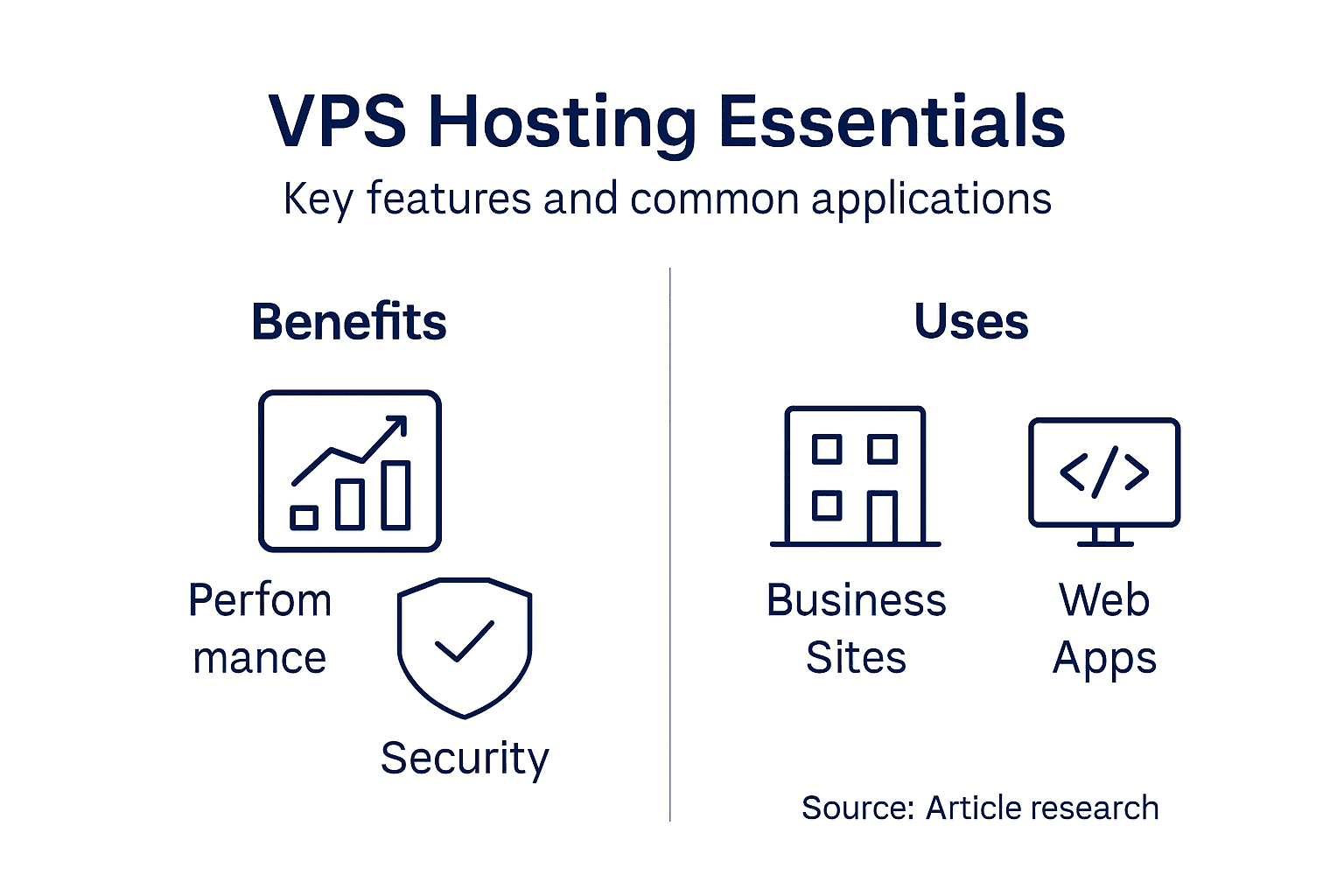
For small to medium businesses, VPS hosting delivers several critical advantages:
- Enhanced Performance: Guaranteed CPU and RAM allocation
- Improved Security: Isolated server environment prevents cross-contamination
- Scalability: Easy resource upgrades without migrating entire infrastructure
- Cost Efficiency: More affordable than dedicated servers
Businesses operating in Switzerland benefit from localized VPS solutions that provide low-latency connections and strict compliance with national data protection standards. This means faster website loading times, more reliable service, and greater control over sensitive digital assets.
Websites experiencing consistent traffic growth or running complex applications will find VPS hosting particularly advantageous. The ability to customize server configurations enables businesses to optimize their digital presence precisely to their operational requirements.
Pro tip: Before selecting a VPS provider, always verify their data center locations and confirm they meet Swiss regulatory compliance standards for data sovereignty and protection.
Types of VPS Hosting Explained
Virtual Private Server (VPS) hosting offers diverse configurations tailored to meet the unique technological requirements of businesses. VPS hosting options in Switzerland typically encompass two primary operating system platforms: Linux and Windows, each delivering distinct advantages for different technical environments.
The main VPS hosting categories include:
- Managed VPS: Full technical support and maintenance handled by hosting provider
- Unmanaged VPS: Complete server control given to the client, requiring advanced technical skills
- Linux VPS: Open-source platform ideal for developers and cost-conscious businesses
- Windows VPS: Microsoft-based environment supporting specific enterprise applications
Businesses must consider several critical factors when selecting their VPS hosting type. Performance requirements, budget constraints, and technical expertise play significant roles in determining the most suitable solution. Linux VPS often provides more flexibility and lower costs, while Windows VPS offers seamless integration with Microsoft ecosystem tools.
Scalability represents another crucial aspect of VPS hosting selection. Modern hosting solutions allow businesses to easily upgrade resources as their digital infrastructure grows, ensuring that server capabilities can adapt to changing operational demands without requiring complete system migration.
Pro tip: Evaluate your technical team’s expertise and specific application requirements before selecting between managed and unmanaged VPS hosting options.
Here’s how different VPS hosting types align with common business needs:
| VPS Type | Best For | Required Skills |
|---|---|---|
| Managed VPS | Non-technical teams | Minimal technical |
| Unmanaged VPS | Experienced IT staff | Advanced server admin |
| Linux VPS | Cost-focused developers | Linux command line |
| Windows VPS | Microsoft app support | Windows server admin |
How VPS Hosting Works Technically
Virtual Private Server (VPS) hosting operates through a sophisticated virtualization technology that transforms a single physical server into multiple isolated virtual environments. Virtual hosting infrastructure enables businesses to create independent server instances with dedicated resources, effectively mimicking a full dedicated server within a shared hardware environment.
The core technical components of VPS hosting include:
- Hypervisor Layer: Software that creates and manages virtual machines
- Resource Allocation: Precise CPU, RAM, and storage distribution
- Network Isolation: Secure separation between virtual server instances
- Containerization: Technology enabling independent server environments
At its fundamental level, VPS hosting uses containerization to divide a physical server into multiple independent segments. Each virtual server receives a guaranteed allocation of computing resources, ensuring consistent performance and preventing interference from other virtual environments. This architectural approach allows businesses to enjoy dedicated server-like capabilities without the significant infrastructure costs associated with physical server ownership.

The virtualization process creates a layer of abstraction between the physical hardware and the virtual server environment. This means each VPS can run its own operating system, have root-level access, and be configured independently, providing businesses with unprecedented flexibility and control over their digital infrastructure.
Pro tip: Select a VPS hosting provider that offers transparent resource allocation and provides detailed metrics about your virtual server’s performance and utilization.
VPS Hosting Costs and Key Benefits
Businesses exploring hosting solutions are increasingly turning to Virtual Private Server (VPS) options that balance performance and affordability. VPS hosting pricing in Switzerland ranges from budget-friendly entry-level plans starting at $4 monthly to more comprehensive configurations supporting complex digital infrastructures.
The key benefits of VPS hosting include:
- Cost Efficiency: Lower expense compared to dedicated servers
- Scalable Resources: Easy upgrade paths as business needs change
- Enhanced Performance: Dedicated CPU and RAM allocation
- Improved Security: Isolated server environments
- Compliance: Alignment with Swiss data privacy regulations
Pricing for VPS hosting depends on several critical factors. Resource allocation plays a significant role, with costs increasing based on CPU cores, RAM capacity, storage type, and bandwidth requirements. Entry-level plans typically provide sufficient resources for small to medium websites, while more advanced configurations support complex enterprise applications and high-traffic platforms.
Businesses gain substantial advantages through VPS hosting’s flexible infrastructure. Unlike shared hosting, VPS provides predictable performance and greater control, enabling companies to customize their server environment precisely to their operational requirements. This approach allows organizations to optimize their digital presence without investing in expensive dedicated server infrastructure.
Pro tip: Calculate your expected resource needs and choose a VPS plan that offers 20% additional capacity to accommodate future growth and unexpected traffic spikes.
VPS vs Shared and Dedicated Hosting
Hosting solutions vary significantly in performance, control, and cost, making it crucial for businesses to understand the key differences between shared, VPS, and dedicated hosting options. Hosting infrastructure comparison reveals that each hosting type serves distinct technological needs and organizational requirements.
The primary differences between hosting types include:
-
Shared Hosting:
- Lowest cost option
- Multiple websites share same server resources
- Limited performance and security
-
VPS Hosting:
- Balanced performance and affordability
- Dedicated resource allocation
- Improved security through isolation
-
Dedicated Hosting:
- Full server control
- Maximum performance and customization
- Highest cost option
VPS hosting emerges as a strategic middle ground for growing businesses. Unlike shared hosting, VPS provides guaranteed CPU and RAM allocation, significantly enhancing website stability and performance. Compared to dedicated servers, VPS offers similar isolation and root-level access at a fraction of the cost, making it an attractive option for companies seeking reliable digital infrastructure without substantial investment.
The virtualization technology behind VPS allows businesses to scale resources dynamically, providing flexibility that neither shared nor dedicated hosting can match. This approach enables companies to optimize their hosting environment precisely to their operational needs, balancing performance requirements with budget constraints.
Below is a side-by-side comparison of hosting solutions based on key attributes:
| Attribute | Shared Hosting | VPS Hosting | Dedicated Hosting |
|---|---|---|---|
| Server Control | Very limited | Full root access | Complete hardware access |
| Performance | Unpredictable | Consistent and scalable | Maximum, non-shared |
| Security | Baseline | Isolated, customizable | Highest, physical isolation |
| Monthly Cost | Lowest | Moderate | Highest |
Pro tip: Assess your website’s traffic patterns and resource consumption before selecting a hosting solution, and choose a plan that offers room for future growth.
Common Issues and Security Considerations
VPS hosting, while powerful, presents unique challenges that businesses must proactively address to maintain optimal performance and security. Swiss VPS security protocols emphasize comprehensive risk management and compliance with stringent data protection regulations.
Potential VPS hosting issues include:
-
Resource Contention:
- Performance impacts from “noisy neighbor” scenarios
- Unexpected resource consumption
- Potential bandwidth limitations
-
Security Vulnerabilities:
- Misconfigured server settings
- Inadequate firewall protection
- Potential unauthorized access risks
-
Maintenance Challenges:
- Regular software updates required
- Constant security patch management
- Need for proactive monitoring
Businesses must implement robust security measures to mitigate potential risks. Root access provides complete server control, but simultaneously demands sophisticated security expertise. Implementing multi-layered security strategies including advanced firewalls, intrusion detection systems, and regular vulnerability assessments becomes critical for maintaining a secure virtual server environment.
Managed VPS solutions offer an alternative for businesses lacking extensive technical infrastructure. These services provide professional monitoring, automatic security updates, and comprehensive threat detection, effectively reducing the complex security burden on internal technical teams.
Pro tip: Conduct quarterly comprehensive security audits and maintain an updated incident response plan to quickly address potential VPS infrastructure vulnerabilities.
Elevate Your Business with Reliable VPS Hosting Solutions
Understanding the importance of VPS hosting means recognizing the challenges of balancing performance, security, and scalability for your growing business. If you are concerned about dedicated resources, data protection, and seamless scalability as highlighted in the article, ThunderHosting offers tailored VPS hosting built to meet these exact needs. With our Swiss-based infrastructure and global data centers in Germany, Singapore, Finland, and the US, you gain localized low-latency connections coupled with international reach.
Key benefits include:
- Dedicated CPU and RAM to ensure constant performance
- Enhanced security through isolated server environments
- Flexible upgrades to match your evolving business demands
Explore our VPS hosting solutions today and experience fast, secure, and customizable online infrastructure. Do not let limited resources or slow support hold you back. Visit ThunderHosting.com now and take the first step toward scalable, reliable hosting that grows with your business.
Frequently Asked Questions
What is VPS hosting?
VPS hosting, or Virtual Private Server hosting, is a type of web hosting that uses virtualization technology to provide dedicated resources within a shared environment. It allows businesses to have their own isolated server environment while sharing the physical hardware with other users.
How does VPS hosting differ from shared hosting?
Unlike shared hosting, where multiple websites share the same server resources resulting in limited performance and security, VPS hosting allocates dedicated CPU and RAM to each virtual server. This offers enhanced performance, reliability, and greater control over the server environment.
What are the benefits of using VPS hosting for my business?
VPS hosting provides numerous benefits including improved performance, enhanced security through isolation, scalability for growing businesses, and cost-efficiency compared to dedicated servers. It allows businesses to manage and customize server configurations to suit their operational needs.
What types of VPS hosting are available?
There are primarily two operating system platforms for VPS hosting: Linux and Windows. Additionally, VPS hosting is categorized as Managed VPS, which offers technical support from the provider, and Unmanaged VPS, which gives full control to the user but requires technical expertise.