

DDoS attacks targeting Swiss small to medium businesses have increased by 30% annually from 2022 to 2025, creating urgent risks for operations and revenue. These attacks flood your services with malicious traffic, causing costly downtime and damaging your reputation. This guide explains what DDoS protection is, how it works technically, and the practical steps Swiss SMEs can take to defend their online presence effectively.
Table of Contents
- Understanding DDoS Attacks
- Why DDoS Protection Matters For Swiss SMEs
- Mechanisms And Solutions Of DDoS Protection
- Types Of DDoS Protection Solutions
- Common Misconceptions About DDoS Protection
- Benefits And Business Impact Of DDoS Protection
- Implementing DDoS Protection For SMEs
- Protect Your Business With Reliable Hosting Solutions
- Frequently Asked Questions About DDoS Protection For Swiss SMEs
Key takeaways
| Point | Details |
|---|---|
| DDoS attacks flood services with malicious traffic from multiple sources disrupting business operations | Swiss SMEs face growing attack frequency with significant revenue and reputation impacts |
| Multi-layered protection combines cloud-based and on-premise solutions for effective defense | Detection, filtering, and absorption work together to neutralize threats before they reach your servers |
| Common myths lead to inadequate preparation | High bandwidth alone does not prevent attacks, and SMEs are increasingly targeted despite size |
| Proper implementation reduces downtime by up to 70% | Measurable improvements in availability and customer trust justify the investment |
| Structured deployment includes risk assessment, solution selection, and continuous monitoring | Swiss SMEs can implement protection without extensive IT teams using managed services |
Understanding DDoS attacks
DDoS attacks work by overwhelming targeted services with excessive traffic from multiple sources, making legitimate user access impossible. A distributed denial of service assault uses networks of compromised devices called botnets to flood your website, application, or network infrastructure simultaneously from hundreds or thousands of locations.
The technical mechanism exploits your finite resources. Attackers saturate bandwidth connections, exhaust server processing capacity, or overwhelm application logic with seemingly legitimate requests. Your infrastructure cannot distinguish attack traffic from real customers fast enough, causing service collapse.
Three primary attack types threaten Swiss SMEs:
- Volumetric attacks flood bandwidth with massive data streams measured in gigabits per second
- Protocol attacks exploit weaknesses in network layer protocols consuming server resources
- Application layer attacks mimic legitimate user behavior targeting specific web application functions
Internet-facing business services are inherently vulnerable because they must remain accessible to customers. Every public IP address, web server, and API endpoint represents a potential attack surface. Without protection, your infrastructure has no mechanism to filter malicious traffic before resources are consumed.
“The challenge for SMEs is that modern DDoS tools are freely available and require minimal technical skill, democratizing attack capabilities for malicious actors worldwide.”
Why DDoS protection matters for Swiss SMEs
DDoS attacks on Swiss SMEs have increased by 30% annually leading to revenue losses and downtime, creating a threat landscape that demands proactive defense. Small and medium businesses now face the same attack sophistication previously reserved for large enterprises, but with fewer resources to respond.
Business consequences extend beyond temporary service interruption. Each hour of downtime translates to lost sales, abandoned shopping carts, and frustrated customers who may never return. Your reputation suffers when clients cannot access your services during critical business periods.
Swiss SMEs face specific vulnerabilities:
- Limited IT budgets restrict security infrastructure investments
- Lean technical teams lack specialized DDoS response expertise
- Legacy hosting environments without modern traffic filtering capabilities
- Dependence on single internet connections creating points of failure
The financial impact compounds quickly. Beyond immediate revenue loss, you incur costs for emergency response, potential ransom demands, customer service overhead, and long-term reputation repair. Many SMEs underestimate these cascading effects until experiencing an attack firsthand.
Smart businesses now choose hosting plans with better uptime guarantees that include DDoS mitigation. The secure website hosting process integrates protection from the foundation rather than bolting it on after an incident. For content management systems, WordPress hosting impact for Swiss SMBs includes specialized defenses against application layer attacks targeting common vulnerabilities.
Mechanisms and solutions of DDoS protection
Multi-layer DDoS protection combining network and application level defenses greatly reduces downtime by implementing detection, filtering, and absorption capabilities that work together. Understanding these mechanisms helps you evaluate solutions effectively.
Detection systems analyze incoming traffic patterns using baseline profiling and anomaly detection algorithms. When traffic volume, packet characteristics, or request patterns deviate from normal behavior, automated alerts trigger mitigation protocols within seconds.
Filtering occurs at multiple layers:
- Network edge routers drop malformed packets and known attack signatures
- Scrubbing centers redirect suspicious traffic through specialized infrastructure
- Web application firewalls analyze HTTP requests for malicious payloads
- Rate limiting prevents any single source from monopolizing resources
Absorption capacity matters because some attacks simply cannot be filtered completely. Cloud-based scrubbing centers maintain massive bandwidth reserves measured in terabits per second, far exceeding what attackers can generate. Your legitimate traffic passes through cleanly while attack traffic is absorbed harmlessly.
Continuous monitoring provides adaptive response. Security teams analyze attack evolution in real time, adjusting filtering rules and absorption thresholds as attackers modify their tactics. This human analysis combined with automation creates resilient defense.

Pro Tip: The secure hosting process should include protection that activates automatically without manual intervention, ensuring defense even outside business hours when attacks often occur.
Types of DDoS protection solutions
Cloud-based solutions offer dynamic scaling and lower upfront costs while on-premise provides lower latency but higher expense, creating distinct trade-offs for Swiss SMEs evaluating protection options.
Cloud-based DDoS protection routes your traffic through provider networks with massive absorption capacity. You pay monthly fees based on bandwidth or protection tiers, eliminating capital expenditure. Scalability is automatic, handling attack volumes that would overwhelm local infrastructure. Managed services mean providers handle configuration, monitoring, and response.
On-premise appliances install at your network edge, filtering traffic before it reaches internal systems. This approach offers microsecond response times and complete control over security policies. However, you need technical expertise for deployment and ongoing management. Capital costs for hardware and software licenses can reach tens of thousands of dollars.
Hybrid approaches combine both models:
- On-premise appliances handle normal traffic and smaller attacks locally
- Cloud scrubbing activates for volumetric attacks exceeding local capacity
- You maintain control while accessing overflow protection
- Suitable for established SMEs with existing IT infrastructure
| Solution Type | Upfront Cost | Monthly Cost | Scalability | Management Effort | Best For |
|---|---|---|---|---|---|
| Cloud-based | Low | Moderate | Unlimited | Minimal | Most SMEs, limited IT staff |
| On-premise | High | Low | Limited | Significant | IT-capable SMEs, compliance needs |
| Hybrid | Moderate | Moderate | High | Moderate | Growing SMEs, mixed requirements |
Pro Tip: Most Swiss SMEs benefit from cloud-based protection initially, transitioning to hybrid models only after outgrowing managed service capabilities. The VPS vs dedicated servers analysis applies similar logic to DDoS solution selection. Explore flexible VPS hosting options that include integrated protection.
Common misconceptions about DDoS protection
High bandwidth alone does not prevent DDoS attacks as attackers scale their traffic accordingly, yet this myth persists among Swiss SMEs making protection decisions. Correcting these misconceptions prevents costly mistakes.
-
Myth: Purchasing high bandwidth internet connections prevents DDoS attacks. Reality: Modern botnets generate hundreds of gigabits per second, overwhelming even enterprise connections. Bandwidth provides no filtering capability, meaning all malicious traffic still reaches your servers. Protection requires intelligent traffic analysis, not just larger pipes.
-
Myth: Only large enterprises are targeted by DDoS attacks. Reality: Swiss SMEs face increasing attacks because perpetrators know smaller businesses lack robust defenses. Attackers use SMEs for testing new techniques, extortion attempts, or competitive sabotage. Your size makes you a target, not a shield.
-
Myth: DDoS protection guarantees 100% uptime during attacks. Reality: Protection significantly reduces risk and minimizes impact, but cannot eliminate all downtime. Sophisticated multi-vector attacks may cause brief service degradation while mitigation activates. The goal is reducing hours of downtime to minutes, not achieving perfection.
-
Myth: Free protection from hosting providers offers adequate defense. Reality: Basic included protection handles small attacks but lacks capacity and sophistication for serious threats. Free tiers often provide minimal bandwidth absorption and limited protocol coverage.
Understanding these realities helps you set appropriate expectations and budget adequately for effective secure website hosting that includes professional-grade DDoS mitigation.
Benefits and business impact of DDoS protection
DDoS protection adoption has reduced downtime by 70% and improves customer retention for Swiss SMEs, demonstrating measurable returns on security investments. The business case extends beyond prevented attacks to operational confidence.
Downtime reduction represents the most quantifiable benefit. Protected businesses experience service interruptions measured in minutes rather than hours when attacks occur. Your customers barely notice mitigation happening in the background, maintaining their trust and completing transactions.
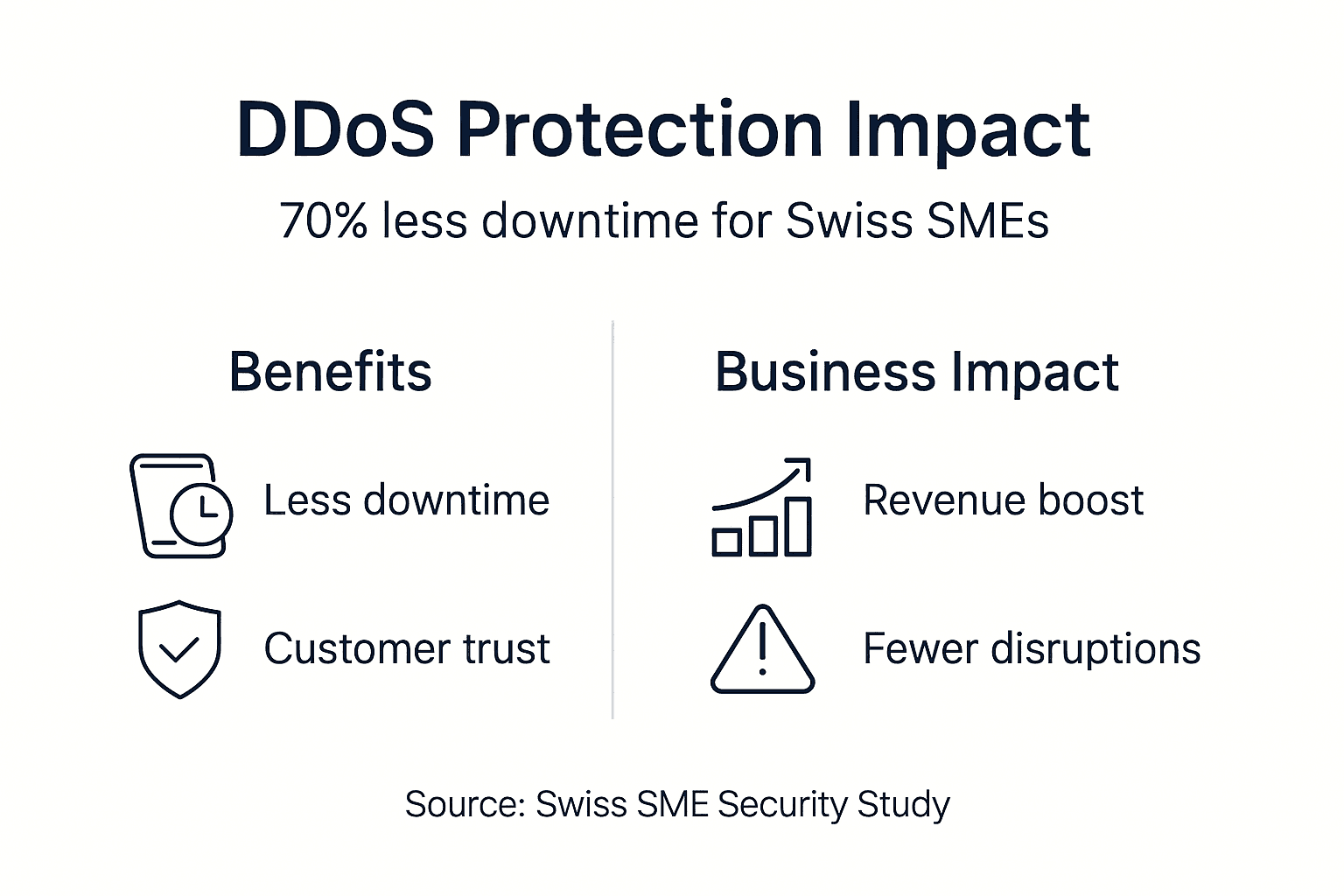
Customer trust strengthens when your services remain available during industry-wide attacks affecting competitors. You demonstrate reliability that differentiates your business. Clients making vendor selections increasingly evaluate security posture, giving protected SMEs competitive advantages.
| Metric | Without Protection | With Protection | Improvement |
|---|---|---|---|
| Average attack downtime | 4.2 hours | 18 minutes | 93% reduction |
| Customer complaint rate during incidents | 34% | 3% | 91% reduction |
| Revenue loss per attack | CHF 8,500 | CHF 400 | 95% reduction |
| Recovery time to normal operations | 12 hours | 45 minutes | 96% reduction |
Cost-benefit analysis favors protection for most Swiss SMEs. Monthly protection costs typically range from CHF 100 to CHF 500 depending on bandwidth and features. A single prevented attack often justifies annual protection expenses. You also avoid emergency response costs, overtime IT labor, and reputation repair campaigns.
“Investing in DDoS protection shifted our mindset from reactive crisis management to proactive security posture, enabling business growth without constant availability anxiety.”
The confidence to reduce downtime with hosting plans that include professional protection allows you to focus on core business activities rather than security firefighting.
Implementing DDoS protection for SMEs
A structured implementation plan including risk assessment and continuous monitoring improves defense effectiveness, providing Swiss SMEs with a clear roadmap from evaluation to deployment.
-
Conduct a risk and vulnerability assessment. Identify all internet-facing assets including websites, email servers, and APIs. Evaluate your current bandwidth capacity and hosting infrastructure capabilities. Document business impact costs for various downtime scenarios. This assessment reveals your specific exposure and helps prioritize protection investments.
-
Choose the appropriate protection solution matching your needs and budget. Most Swiss SMEs benefit from cloud-based managed services offering immediate deployment and predictable costs. Evaluate providers based on scrubbing capacity, geographic proximity of filtering infrastructure, and support responsiveness. Request trial periods to test performance impact on legitimate traffic.
-
Deploy detection and filtering integrated with your current hosting environment. Cloud solutions typically require DNS changes routing traffic through provider networks before reaching your servers. Configure threshold alerts and escalation procedures. Test thoroughly using simulation tools to verify mitigation activates correctly.
-
Establish continuous monitoring and response protocols. Review attack logs weekly to understand threat patterns targeting your business. Update filtering rules quarterly as your applications evolve. Schedule annual assessments to verify protection scales with business growth.
Pro Tip: The secure website hosting process should integrate DDoS protection from initial deployment rather than adding it after experiencing attacks. Selecting high performance affordable web hosting with built-in protection eliminates implementation complexity.
Protect your business with reliable hosting solutions
Swiss SMEs need hosting infrastructure that combines performance with security. Implementing DDoS protection becomes seamless when your hosting provider integrates defenses at the infrastructure level.
ThunderHosting delivers tailored solutions designed specifically for Swiss business requirements. Our high performance affordable web hosting includes multi-layer DDoS protection as standard, eliminating the complexity of separate security services. You gain immediate defense against volumetric and application layer attacks without configuration headaches.
The secure website hosting process guides you through selecting appropriate protection levels based on your traffic patterns and business criticality. For demanding applications requiring dedicated resources, our high-performance dedicated servers provide enterprise-grade protection with Swiss-based support teams available when you need assistance.
Our infrastructure leverages global scrubbing centers while maintaining low-latency connections to Swiss users. You benefit from massive absorption capacity without sacrificing the performance your customers expect. Expert support teams help you understand attack patterns and optimize your defenses as threats evolve.
Frequently asked questions about DDoS protection for Swiss SMEs
How quickly can DDoS protection detect an attack?
Modern systems detect volumetric attacks within 5 to 15 seconds using automated traffic analysis. Application layer attacks may take 30 to 60 seconds as systems differentiate malicious requests from legitimate traffic spikes. Mitigation typically activates within one minute of detection, minimizing service impact.
What is the typical cost range for DDoS protection for SMEs?
Cloud-based managed protection costs CHF 100 to CHF 500 monthly depending on bandwidth requirements and protection features. Entry-level plans suitable for most Swiss SMEs start around CHF 150 monthly. On-premise appliances require CHF 15,000 to CHF 50,000 initial investment plus annual maintenance fees.
Can I implement DDoS protection without technical IT staff?
Yes, cloud-based managed services handle all technical aspects including configuration, monitoring, and response. Providers offering secure website hosting integrate protection during initial setup. You simply update DNS records to route traffic through provider networks, requiring no specialized security expertise.
How often should DDoS protection settings be reviewed or updated?
Review protection configurations quarterly to accommodate business changes like new applications or traffic pattern shifts. Conduct annual comprehensive assessments evaluating whether your protection tier matches current business scale. Update filtering rules immediately when deploying new web services or APIs.
Does mitigation affect website performance for legitimate users?
Properly configured protection adds 5 to 20 milliseconds latency as traffic routes through scrubbing infrastructure, imperceptible to users. During active attacks, you may implement challenge mechanisms like CAPTCHA for suspicious sources, briefly affecting some visitors. Outside attack periods, performance impact is negligible compared to benefits.