

Managing a growing online gaming platform can quickly overwhelm even the most seasoned Swiss e-commerce entrepreneur when player lag and security threats disrupt gameplay. Smooth multiplayer experiences depend on more than just clever game design—they require dedicated game server hosting designed for speed, reliability, and global connections. Investing in robust hosting not only cuts down on player frustration but also supports your business’s reputation by offering consistently responsive and secure gaming sessions.
Table of Contents
- Game Server Hosting Explained For Beginners
- Popular Game Server Hosting Types And Models
- How Game Server Hosting Improves Multiplayer Platforms
- Cost, Security, And Performance Considerations
- Choosing The Right Game Server Host In Switzerland
Key Takeaways
| Point | Details |
|---|---|
| Game Server Hosting Importance | Game server hosting is essential for delivering smooth multiplayer experiences by providing high-performance hardware and global connectivity. |
| Hosting Models | Various hosting models, such as Dedicated, Cloud-Based, and Peer-to-Peer, cater to different gaming needs, offering unique trade-offs in scalability and performance. |
| Security and Cost Considerations | Prioritize security and understand associated costs, as robust hosting solutions protect against threats while balancing performance with financial sustainability. |
| Selecting a Swiss Host | When choosing a game server host in Switzerland, evaluate factors like network latency, data privacy, and hardware quality to ensure optimal player experiences. |
Game Server Hosting Explained for Beginners
Multiplayer gaming requires specialized infrastructure to deliver smooth, responsive experiences. Game server hosting provides the technological backbone that enables players worldwide to connect, compete, and collaborate in virtual environments. Game servers act as centralized communication hubs that manage critical gameplay functions like player authentication, game state synchronization, and real-time data processing.
These dedicated computing systems handle complex responsibilities that individual player computers cannot efficiently manage. Game server hosting solutions offer several key advantages:
- High-Performance Hardware: Powerful processors and robust network connections
- Global Connectivity: Low-latency servers positioned strategically around the world
- Security Protocols: Protection against cheating, hacking, and unauthorized access
- Scalable Infrastructure: Ability to support hundreds or thousands of simultaneous players
Game server hosting transforms multiplayer experiences by providing reliable, professional-grade technological infrastructure. Without specialized hosting, online multiplayer games would suffer from significant performance limitations, making seamless global interactions impossible.
Pro tip: When selecting a game server host, prioritize providers with multiple geographic data center locations to ensure the lowest possible network latency.
Popular Game Server Hosting Types and Models
Game server hosting encompasses multiple architectural models designed to meet diverse multiplayer gaming requirements. Different server architectures offer unique performance trade-offs that impact gameplay experience, scalability, and resource management. Understanding these models helps developers and gamers select the most appropriate hosting solution for their specific needs.
The primary game server hosting models include:
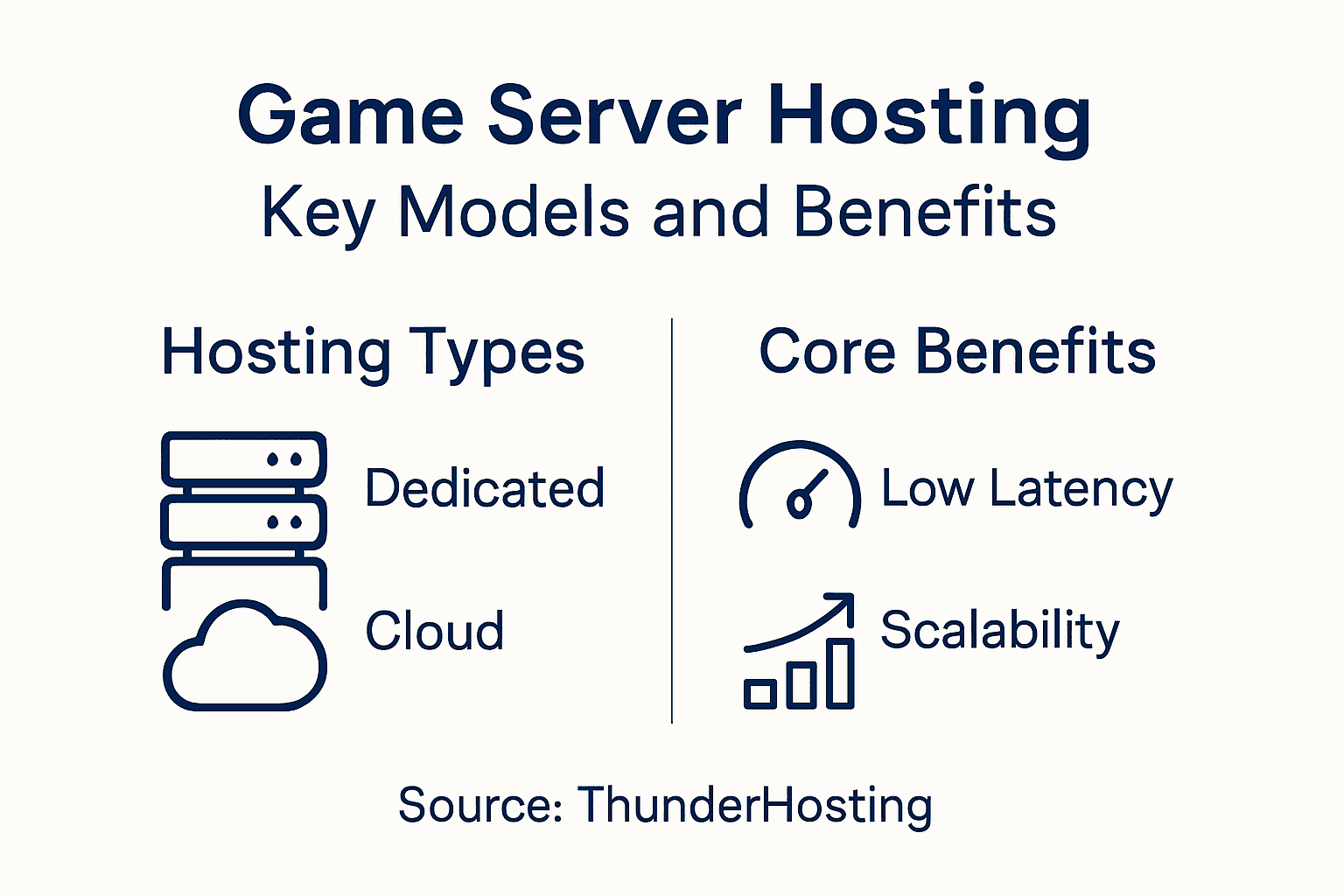
- Dedicated Game Servers: Exclusive hardware resources providing maximum performance and control
- Listen Servers: Player-hosted environments suitable for small-scale multiplayer interactions
- Peer-to-Peer (P2P) Servers: Direct player connections without centralized infrastructure
- Cloud-Based Servers: Dynamically scalable platforms adapting to fluctuating player demands
Each hosting model presents distinct advantages and limitations. Dedicated game servers excel in massive multiplayer environments, offering robust performance and comprehensive security protocols. Cloud-based servers provide flexibility, allowing game developers to scale resources instantaneously based on player traffic. Listen servers remain popular for local multiplayer scenarios, while peer-to-peer architectures can reduce operational costs for smaller gaming communities.
Here’s a quick comparison of popular game server hosting models:
| Hosting Model | Ideal Use Case | Scalability | Performance Level |
|---|---|---|---|
| Dedicated Server | Large MMOs, esports | Moderate, hardware-based | Highest control and speed |
| Listen Server | LAN, local play, small groups | None, host-dependent | Limited, tied to host PC |
| Peer-to-Peer (P2P) | Small co-op games, casual | Fixed, equal peers | Varies, often inconsistent |
| Cloud-Based Server | Games with changing demands | Excellent, on demand | High, but depends on provider |
Pro tip: Evaluate your game’s specific network requirements and player base size when selecting a server hosting model to optimize performance and player experience.
How Game Server Hosting Improves Multiplayer Platforms
Multiplayer gaming platforms rely on sophisticated technological infrastructure to create seamless, responsive player experiences. Advanced networking systems enable global player interactions by managing complex synchronization challenges and reducing communication latency. Game server hosting transforms online multiplayer environments by providing robust, intelligent network management solutions.
The key improvements offered by game server hosting include:
- Real-Time Synchronization: Ensuring consistent gameplay states across all connected players
- Latency Reduction: Minimizing delay between player actions and server responses
- Security Enforcement: Preventing cheating and unauthorized gameplay modifications
- Scalable Infrastructure: Supporting hundreds or thousands of simultaneous players
- Geographic Flexibility: Connecting players across different global regions
Modern game server hosting goes beyond simple connection management. Distributed server architectures enable dynamic resource allocation, allowing games to adapt instantly to changing player demands. These sophisticated systems implement advanced algorithms that prioritize network efficiency, maintain gameplay integrity, and create immersive multiplayer experiences that feel responsive and seamless.

Pro tip: Select game server hosting solutions that offer multiple global data center locations to minimize player latency and improve overall gaming performance.
Cost, Security, and Performance Considerations
Game server hosting involves complex trade-offs between technological performance, security requirements, and financial investments. Game server security protocols protect against critical digital threats that can compromise player experiences and potentially expose sensitive user data. Understanding these interconnected factors is crucial for making informed hosting decisions.
Key considerations for game server hosting include:
- Hardware Resources: Impact of CPU, RAM, and storage on gameplay performance
- Security Measures: Protection against DDoS attacks and unauthorized access
- Network Infrastructure: Latency reduction and consistent connection quality
- Scalability Costs: Expenses associated with expanding server capabilities
- Maintenance Expenses: Ongoing technical support and system upgrades
Comprehensive security strategies require multi-layered approaches that balance technological sophistication with cost-effectiveness. High-performance game servers demand significant computational resources, with NVMe SSD storage and powerful processors directly influencing player experience. Hosting providers must continuously invest in advanced network infrastructure to maintain competitive service quality while managing operational expenses.
Pro tip: Calculate total cost of ownership by considering not just monthly hosting fees, but also potential security investments and potential revenue impact from performance issues.
Choosing the Right Game Server Host in Switzerland
Swiss hosting infrastructure provides unique advantages for game server performance, offering exceptional network stability and strategic European connectivity. Game developers and community managers seeking reliable hosting must carefully evaluate multiple critical factors to ensure optimal player experiences. Switzerland’s robust technological ecosystem enables high-performance, secure game server environments.
Key considerations for selecting a Swiss game server host include:
- Network Latency: Proximity to major European internet exchange points
- Data Privacy: Compliance with strict Swiss data protection regulations
- Hardware Quality: Enterprise-grade servers with high-performance specifications
- Security Frameworks: Advanced protection against cyber threats
- Scalability Options: Flexible infrastructure supporting game growth
Performance metrics play a crucial role in hosting selection. Professional game server hosts in Switzerland distinguish themselves through comprehensive service offerings that balance technical sophistication with reliable infrastructure. Sophisticated cooling systems, redundant network connections, and rapid deployment capabilities ensure minimal downtime and consistent gameplay experiences for international gaming communities.
The table below summarizes critical factors to review when choosing a Swiss game server host:
| Factor | Importance for Gamers | Swiss Advantage |
|---|---|---|
| Latency | Smooth cross-region gameplay | Proximity to EU hubs |
| Data Privacy | Protects player information | Strong legal safeguards |
| Hardware Quality | Consistent performance | Enterprise components |
| Security | Prevents hacking, downtime | Advanced defense layers |
| Scalability | Supports growing player base | Flexible Swiss infrastructure |
Pro tip: Request detailed technical specifications and performance guarantees from potential hosting providers, including specific metrics about uptime, network latency, and hardware configurations.
Unlock Seamless Multiplayer Experiences with Expert Game Server Hosting
Understanding the importance of game server hosting is the first step toward delivering smooth, low-latency multiplayer gameplay. If you face challenges like high latency, unreliable connections, or limited scalability, you are not alone. Many gamers and developers seek game server solutions that offer high-performance hardware, robust security, and geographically distributed data centers to ensure global connectivity and responsive gameplay.
ThunderHosting stands out with expertise in scalable game server hosting that empowers you to overcome these hurdles. Our infrastructure in Ticino, Switzerland, and additional global locations like Germany, Singapore, and the US, ensures your players experience consistent low latency and top-tier performance. Whether you need dedicated servers or cloud-based solutions, our customizable options and expert support let you focus on what matters most: your game community.
Explore more about our hosting solutions that make advanced game server hosting accessible to everyone.

Ready to deliver the reliable multiplayer experience your players demand? Visit ThunderHosting today to choose the perfect game server infrastructure and boost your game performance now.
Frequently Asked Questions
What is game server hosting?
Game server hosting provides the technological infrastructure that allows players around the world to connect and participate in multiplayer gaming. It manages critical gameplay functions, such as player authentication and game state synchronization, ensuring a smooth and responsive gaming experience.
What are the advantages of using dedicated game servers?
Dedicated game servers offer maximum performance and control by utilizing exclusive hardware resources. They provide robust security measures and can support large-scale multiplayer environments, making them ideal for massive online games and esports.
How do cloud-based game servers work?
Cloud-based game servers dynamically scale resources based on player demand, allowing game developers to efficiently manage fluctuating player populations. This flexibility ensures optimal performance and resource allocation during peak gaming times.
What key factors should I consider when choosing a game server host?
When selecting a game server host, consider hardware quality, security measures, network latency, scalability options, and the provider’s overall service reliability. These factors determine the effectiveness and performance of your multiplayer gaming environment.