

Finding the right game hosting solution often feels like a challenge for small and medium-sized developers in Switzerland who need maximum reliability and minimal latency for their online titles. Reliable hosting is the foundation that keeps multiplayer games running smoothly, making every player connection consistent and responsive. By exploring authoritative game server infrastructure, developers can discover options that boost performance, keep latency low, and deliver enjoyable online experiences from Switzerland to the wider world.
Table of Contents
- Defining Game Hosting For Online Games
- Types Of Game Hosting Solutions Compared
- How Game Hosting Powers Multiplayer Play
- Performance, Security, And Latency Factors
- Cost Structures And Common Pitfalls
- Choosing The Right Game Hosting Partner
Key Takeaways
| Point | Details |
|---|---|
| Game Hosting Importance | Game hosting is crucial for smooth online multiplayer experiences, enabling real-time player interactions and minimizing latency. |
| Types of Hosting Solutions | Choose the right hosting type (e.g., Dedicated, Cloud, Shared) based on specific game requirements, player count, and budget. |
| Performance and Security | Prioritize performance metrics and security measures, including latency management and DDoS protection, to ensure a reliable gaming environment. |
| Cost Management Strategies | Implement transparent cost structures and avoid common pitfalls to maintain financial viability throughout game development and hosting. |
Defining Game Hosting for Online Games
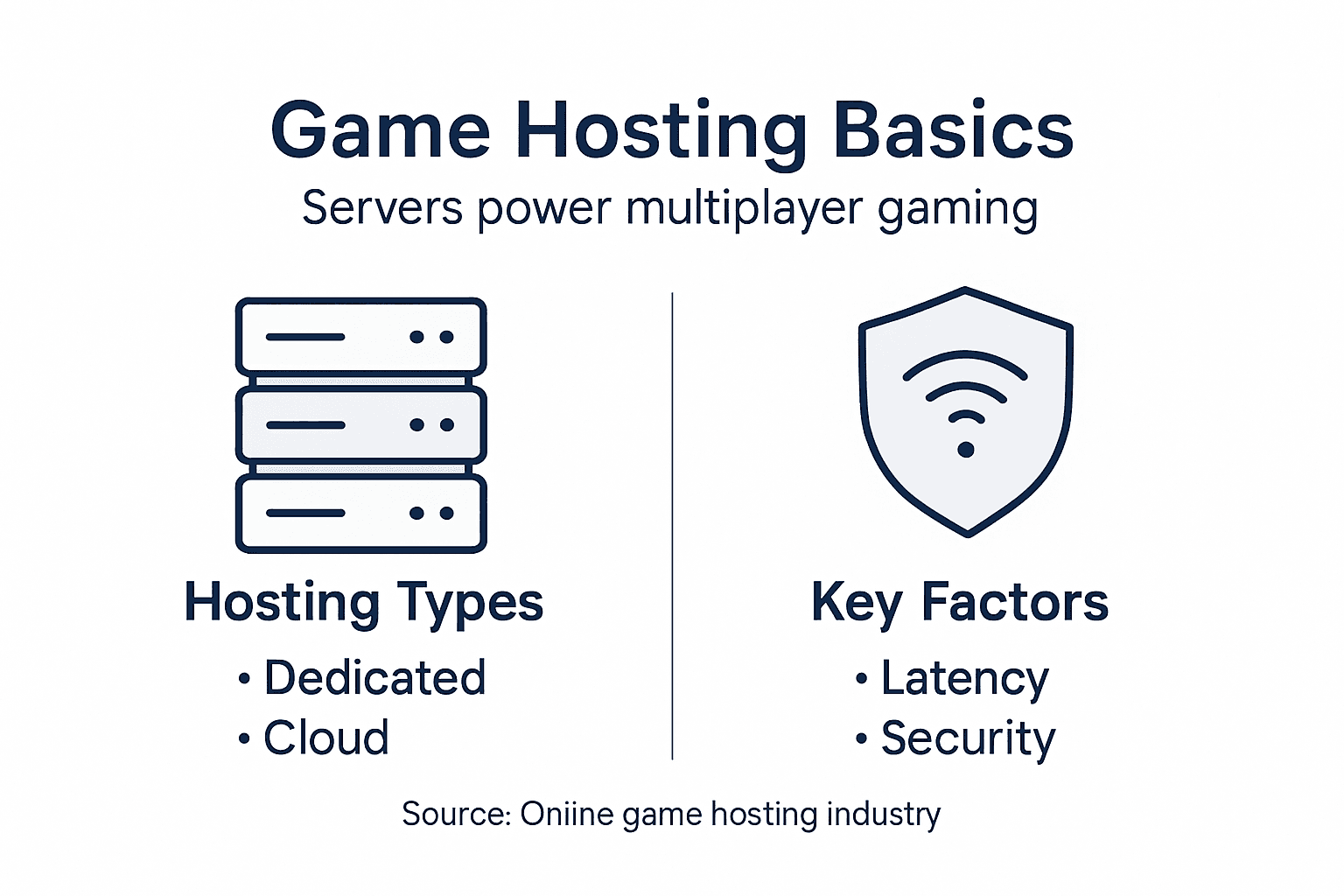
Game hosting is the technological backbone that enables online multiplayer gaming experiences by providing specialized server infrastructure dedicated to running and managing game environments. At its core, a game server acts as the authoritative source for processing player interactions, maintaining game state, and synchronizing gameplay across multiple connected participants.
In practical terms, game hosting involves several critical technical components:
- Dedicated hardware located in professional data centers
- High-performance network infrastructure
- Specialized software for game world simulation
- Real-time data processing capabilities
- Secure player authentication systems
These servers do far more than simply store game data. They actively manage complex interactions by processing player inputs, tracking game states, and transmitting critical information between participants. Professional game hosting ensures minimal latency, robust performance, and a seamless multiplayer experience that feels responsive and engaging.
Game hosting falls within the broader data processing and hosting services sector, representing a sophisticated technological infrastructure that supports interactive digital entertainment. For game developers in Switzerland and globally, reliable hosting means the difference between a smooth, enjoyable gaming experience and a frustrating, laggy environment.
Pro tip: Always evaluate game hosting providers based on their network infrastructure, data center locations, and real-world performance metrics rather than just advertised specifications.
Types of Game Hosting Solutions Compared
Game hosting encompasses multiple technological approaches designed to support different gaming needs and performance requirements. Game server solutions can be categorized into several distinct models, each offering unique advantages for developers and players alike.
The primary types of game hosting solutions include:
- Dedicated Hosting: Single-tenant servers providing maximum performance and control
- Cloud Hosting: Scalable, virtualized infrastructure with flexible resource allocation
- Shared Hosting: Cost-effective option with multiple games sharing server resources
- Peer-to-Peer Hosting: Decentralized model distributing server responsibilities among players
Dedicated hosting represents the gold standard for professional game developers. These servers offer exclusive hardware resources, guaranteeing consistent performance and minimal latency. Professional data centers house these servers, ensuring robust network connectivity and advanced cooling systems that maintain optimal server temperatures.
Hybrid hosting models are emerging as a sophisticated solution, blending dedicated and cloud infrastructures to optimize cost and performance. This approach allows game developers to dynamically scale resources based on player demand, creating more responsive and adaptable gaming environments.
Game developers must carefully evaluate hosting solutions based on specific requirements like player count, game complexity, and budget constraints. Each hosting type presents unique trade-offs between performance, scalability, and cost-effectiveness.
Here’s a comparison of common game hosting models and ideal use scenarios:
| Hosting Model | Best For | Scalability | Control Level |
|---|---|---|---|
| Dedicated Hosting | Large-scale, competitive MMOs | Fixed, high-capacity | Full server control |
| Cloud Hosting | Games with user spikes | Highly dynamic | Moderate, API-driven |
| Shared Hosting | Small indie titles | Limited | Minimal, shared access |
| Peer-to-Peer Hosting | Casual multiplayer parties | Host device limited | Peer player managed |
Pro tip: Consider conducting thorough performance testing across different hosting models to identify the most suitable solution for your specific game architecture and anticipated player load.
How Game Hosting Powers Multiplayer Play
Game servers are the critical technological infrastructure that transforms individual gaming experiences into dynamic, interconnected multiplayer worlds. These sophisticated systems act as the central nervous system of online gaming, processing player inputs, maintaining game states, and ensuring seamless interactions across multiple participants.
The core functions of game hosting include:
- Real-time player input processing
- Game state synchronization
- Latency management
- Player authentication
- Secure communication channels
Modern game hosting leverages advanced technologies to minimize delays and create responsive gameplay. Edge computing and cloud technologies have revolutionized multiplayer experiences by strategically positioning servers closer to players, dramatically reducing lag and improving overall responsiveness.

The technical complexity of game hosting goes far beyond simple data transmission. Servers must simultaneously manage complex calculations, validate player actions, prevent cheating, and maintain a consistent game world for all participants. This requires sophisticated algorithms that can process thousands of events per second while maintaining fairness and preventing exploitation.
Geographic server placement plays a crucial role in multiplayer performance. By distributing servers across different regions, game hosting providers can ensure that players from various locations experience minimal latency and consistent gameplay quality.
Pro tip: Prioritize game hosting solutions that offer multiple server locations and advanced network routing to optimize player experiences across different geographic regions.
Performance, Security, and Latency Factors
Network latency represents the critical heartbeat of multiplayer gaming, determining the real-time responsiveness and overall player experience. Latency directly impacts players’ Quality of Experience, creating fundamental challenges for game developers and hosting providers in maintaining smooth, synchronized gameplay.
Key performance and security considerations include:
- Millisecond-level response times
- Robust DDoS protection mechanisms
- Real-time traffic monitoring
- Secure player authentication protocols
- Geographic server distribution
- Scalable infrastructure design
Game hosting providers must implement sophisticated strategies to mitigate performance risks. Edge computing architectures have emerged as a powerful solution, strategically positioning data centers to minimize network delays and enhance overall game responsiveness. These advanced infrastructures can reduce latency by routing player connections through geographically proximate servers.
Security represents another critical dimension of game hosting performance. Sophisticated hosting solutions must simultaneously protect against multiple threat vectors, including distributed denial-of-service attacks, unauthorized access attempts, and potential gameplay exploitation. This requires continuous monitoring, advanced encryption protocols, and dynamic traffic analysis to maintain a secure gaming environment.
The intersection of performance and security demands a holistic approach. Hosting providers must balance low-latency connections with robust protective measures, ensuring that security implementations do not compromise gameplay responsiveness.
Pro tip: Regularly conduct comprehensive network performance tests and penetration assessments to identify and address potential latency and security vulnerabilities before they impact player experience.
Cost Structures and Common Pitfalls
Game hosting cost structures represent a complex landscape of financial considerations that can quickly become challenging for developers and publishers. Cost management strategies must account for both predictable and unpredictable expenses that can dramatically impact a game’s economic viability.
The primary cost components include:
- Initial server hardware investments
- Ongoing data center operational expenses
- Bandwidth usage and data transfer costs
- Scalability infrastructure
- Security and compliance measures
- Technical support and maintenance
Understanding the nuanced financial dynamics of game hosting requires a comprehensive approach. Developers frequently encounter several critical pitfalls that can rapidly escalate expenses, including underestimating scaling requirements, neglecting security investments, and failing to implement robust cost monitoring mechanisms.
To help developers avoid costly mistakes, here is a summary of common cost pitfalls and their consequences:
| Pitfall | Why It Happens | Potential Impact |
|---|---|---|
| Underestimating player surges | Failing to project scaling needs | Unplanned downtime, lost revenue |
| Overlooking variable bandwidth | Ignoring traffic spikes | Large, unexpected charges |
| Skimping on security investment | Budgeting only for basic threats | Data breaches, disrupted service |
| Lack of transparent cost tracking | No real-time monitoring tools | Inaccurate forecasting, surprises |
Variable expenses pose significant challenges in game hosting economics. Bandwidth consumption, player count fluctuations, and unexpected traffic surges can transform seemingly stable budgets into financial uncertainties. Smart hosting strategies involve implementing flexible infrastructure that can dynamically adjust to changing computational demands without incurring excessive overhead.
Transparency in cost structures becomes paramount for game developers seeking predictable financial models. Hosting providers must offer clear, granular pricing breakdowns that enable precise budgeting and prevent unexpected financial surprises.
Pro tip: Develop a comprehensive cost projection model that includes potential scaling scenarios and buffer funds for unexpected infrastructure requirements.
Choosing the Right Game Hosting Partner
Selecting an ideal game hosting partner requires a strategic approach that goes beyond surface-level considerations. Infrastructure stability assessment becomes critical in determining the long-term success of your multiplayer gaming project, with each decision potentially impacting player experience and game performance.
Key evaluation criteria for game hosting partners include:
- Global data center distribution
- Proven uptime guarantees
- Scalable infrastructure capabilities
- Advanced security protocols
- Comprehensive technical support
- Performance monitoring tools
- Transparent pricing structures
Technical specifications matter immensely, but the most successful partnerships emerge from providers who understand the unique dynamics of interactive gaming environments. Hosting partners must demonstrate flexibility in handling rapid player base growth, sudden traffic spikes, and complex computational requirements specific to different game genres.
The selection process demands thorough due diligence. Game developers should request comprehensive performance benchmarks, detailed security documentation, and case studies demonstrating successful deployments in similar gaming contexts. Potential hosting partners must prove they can deliver consistent, low-latency experiences across diverse geographic regions.
Beyond technical capabilities, cultural alignment between game developers and hosting providers plays a crucial role. A hosting partner who comprehends the nuanced challenges of interactive entertainment can become a strategic ally in navigating complex technological landscapes.
Pro tip: Request detailed service level agreements and conduct rigorous stress testing before committing to any game hosting partnership.
Experience Seamless Game Hosting with ThunderHosting
The article highlights the crucial challenges of minimizing latency, ensuring robust security, and managing scalable infrastructure for smooth multiplayer gaming. If you are looking to overcome these common hurdles such as unpredictable player surges, geographic server placement, and cost transparency, ThunderHosting provides the tailored solutions you need. Our global network includes data centers in Germany, Singapore, Finland, and US regions to guarantee low latency and high performance for gamers everywhere.

Take your multiplayer gaming to the next level by partnering with a provider who truly understands the demands of game hosting. ThunderHosting offers flexible options including dedicated servers, VPS, and shared hosting so you can pick the right fit for your game’s scale and complexity. Explore our services at ThunderHosting and discover how easy setup, comprehensive support, and custom configurations can turn your game into a seamless, engaging experience. Start building your dream game environment today by visiting ThunderHosting and learn more about our game hosting solutions.
Frequently Asked Questions
What is game hosting?
Game hosting refers to the specialized server infrastructure that provides the technological backbone for online multiplayer gaming experiences, managing game environments and player interactions.
What are the different types of game hosting solutions?
Game hosting solutions include dedicated hosting, cloud hosting, shared hosting, and peer-to-peer hosting, each with its own advantages and use cases depending on performance needs and budget constraints.
How does game hosting impact multiplayer gameplay?
Game hosting is critical in ensuring real-time player input processing, game state synchronization, and low latency, which collectively enhance the responsiveness and overall quality of multiplayer gaming experiences.
Why is latency important in game hosting?
Latency affects the real-time responsiveness of multiplayer games. Low latency ensures smoother gameplay, quicker reaction times, and a more engaging experience for players, making it a key factor in game hosting performance.